Series · Raising Dharmic Americans
Part 4 of 5
The Living Calendar:
How Hindu Festivals Pass Culture, Language & Soul to the Next Generation
Culture is not preserved in a box. It is passed forward — in the smell of ghee on a flame, in a grandmother's voice teaching a shloka, in the color that explodes across your child's face on Holi morning.
DharmikAmerica.com
·
Raising Dharmic Americans
·
Part 4 of 5
Every festival is a classroom — and joy is the teacher.
Every culture transmits itself through celebration. Not through textbooks, not through lectures, not even through the most patient parental explanation — but through joy. Through the senses. Through the body's memory of light, color, sound, and taste. A child who has danced Garba, who has burst a mathki on Janmashtami, who has stayed up past midnight on Diwali watching the sky fill with light — that child carries their culture somewhere deeper than the mind. They carry it in their bones.
This is the genius of the Hindu festival calendar. It does not ask children to believe first and celebrate later. It invites them into the celebration, lets the joy take root, and trusts that meaning will follow. And it does — if parents take the time to connect the joy to the story, the story to the Dharma, and the Dharma to life.
"Don't just celebrate the festival. Tell them why. The joy opens the door — the meaning is what makes them stay."
The Hindu festival year
Six major festivals — their meaning, their joy, and how to make them live in an American home
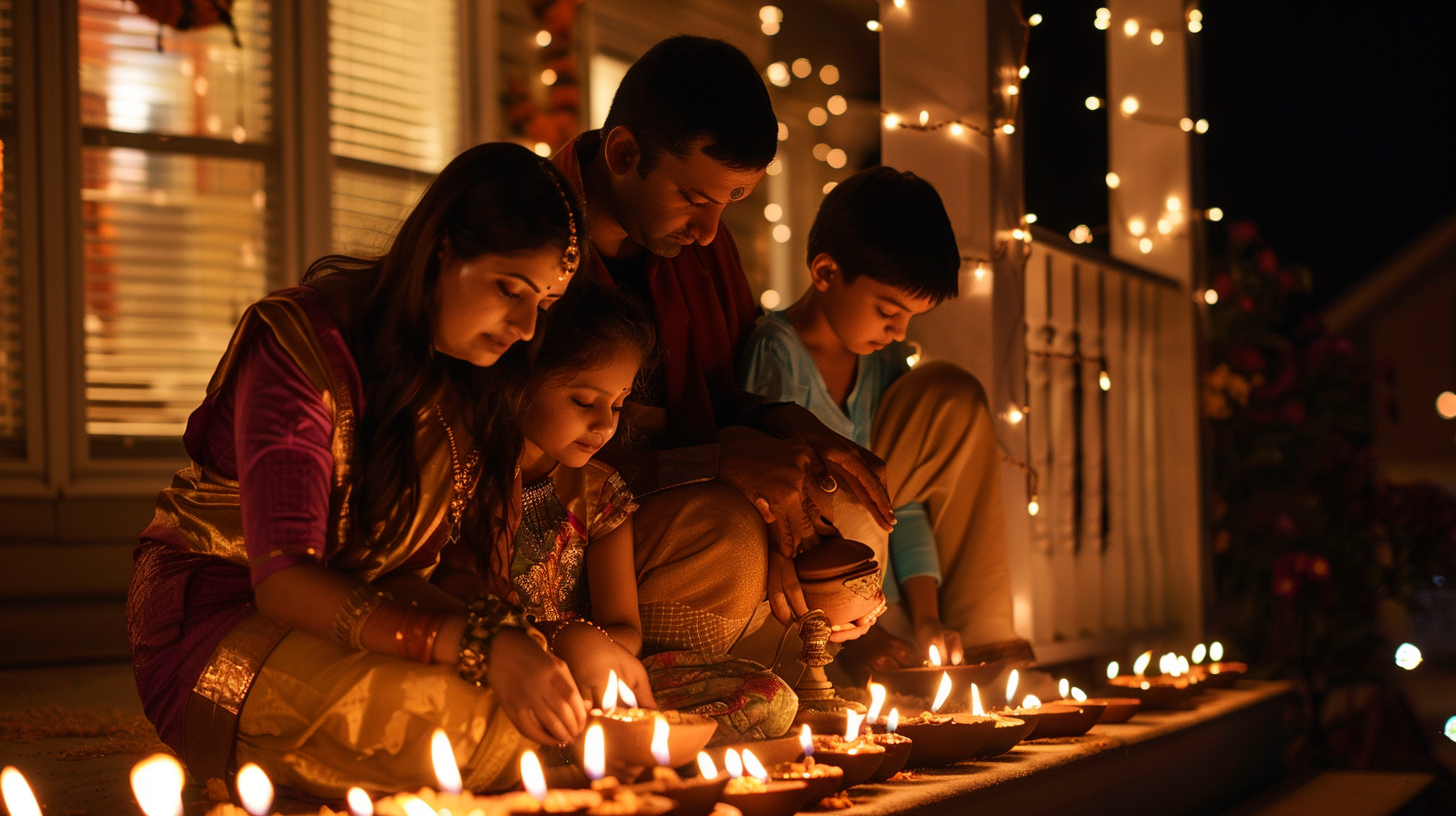
Every lamp lit on Diwali is a statement: light wins.
Diwali is the crown jewel of the Hindu calendar — and the one most visible to American neighbors, schools, and workplaces. But its power runs far deeper than its beauty. Diwali celebrates the return of Rama after fourteen years of exile, the victory of light over darkness, knowledge over ignorance, and the divine over the destructive. Every lamp lit on Diwali is a statement: light wins.
In an American home, Diwali is also your most powerful cultural ambassador. It is the festival most likely to draw in curious neighbors, classmates, and colleagues — and therefore the festival most worth celebrating with full intention and open doors.
Dharmic meaning
Victory of light over darkness; Rama's return; Lakshmi's blessing of abundance
For your child
Let them light every diya. Explain each one as a prayer. Invite a classmate to see the lights.
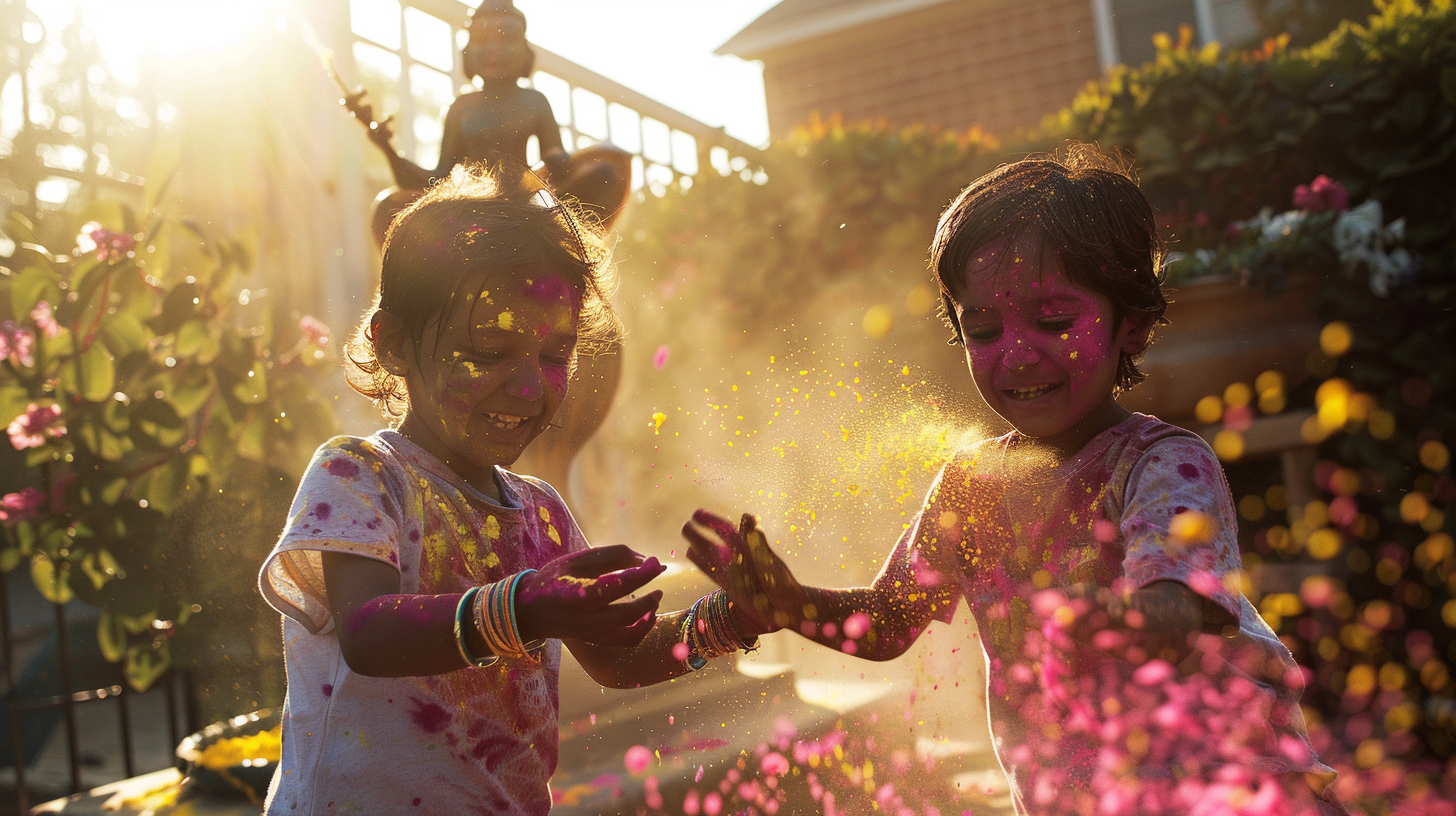
Joy that is felt deeply enough becomes faith.
No festival on earth looks quite like Holi — and no festival is more naturally irresistible to American-born children. The explosion of color, the water, the music, the complete social leveling of the celebration — Holi is Dharma's annual reminder that joy is sacred, that renewal is possible, and that the divine loves to play.
Holi celebrates the victory of devotion over arrogance — the story of Prahlad, whose faith survived every attempt to destroy it — and the arrival of spring as cosmic renewal. But for children, Holi is first and always about joy. Let it be. Joy that is felt deeply enough becomes faith.
Dharmic meaning
Victory of devotion over ego; spring renewal; divine playfulness of Krishna
For your child
Play fully — get colorful. Tell the story of Prahlad at dinner the night before.
Nine nights of Devi — the circle of Garba is the cycle of creation itself.
Navratri is nine nights of worship of the divine feminine — Durga, Lakshmi, and Saraswati — each representing a different aspect of Shakti: power, abundance, and wisdom. The Garba dance that fills these nights is one of Hinduism's most beautiful gifts to the world — a circular dance that symbolizes the cycle of creation, and one that even the shyest American-born child almost always falls in love with.
Navratri is also a profound opportunity to teach your daughter — and your son — about the sacred feminine in Dharma. In a culture that often reduces the divine to masculine forms, Hinduism's celebration of Devi is radical, ancient, and extraordinarily relevant.
Dharmic meaning
Worship of divine feminine Shakti in three forms; victory of Durga over Mahishasura
For your child
Teach Garba — even basic steps. Let them dress in traditional clothes. Explain Devi's three forms.
The divine child who became the greatest philosopher — Krishna's birthday is the door to the Gita.
Janmashtami celebrates the birth of Krishna — the divine child, the charioteer of the Gita, the supreme philosopher disguised as a cowherd. It is one of the most beloved festivals in the Hindu world, celebrated with midnight prayers, fasting, and the joyful Dahi Handi tradition where teams form human pyramids to break a pot of curd.
For children, Janmashtami is irresistible — the stories of baby Krishna stealing butter, playing tricks, enchanting everyone around him with his laughter. These stories carry deep teachings about divine playfulness, about the relationship between the human and the divine, and about joy as a spiritual path.
Dharmic meaning
Birth of Krishna; divine descending into human form; Bhakti as the path of love
For your child
Dress a baby Krishna murti together. Make and share butter. Read the birth story at midnight.
The murti made by their own hands is the one they will remember for a lifetime.
Ganesh — the remover of obstacles, the lord of beginnings, the patron of wisdom and learning — is perhaps the most universally beloved figure in Hinduism. Ganesh Chaturthi celebrates his birth over ten days, culminating in a joyful procession and immersion.
Children are almost universally drawn to Ganesha — his elephant head, his mouse vehicle, his love of modaks, his cheerful round form. Use that natural affinity. Let Ganesha be the first deity your child knows deeply — the one whose qualities of wisdom, perseverance, and joy they can consciously aspire to.
Dharmic meaning
Remover of obstacles; lord of beginnings and wisdom; first among devas to be invoked
For your child
Make clay Ganesha together. Learn the Ganapati Atharvashirsha. Make modaks as a family.
Love that creates obligation — the most Dharmic relationship there is.
Raksha Bandhan — the tying of a sacred thread — is one of Hinduism's most tender celebrations of relationship. A sister ties a rakhi on her brother's wrist; he promises to protect her. The gesture is simple. The meaning is vast: that love creates obligation, that family bonds are sacred, that the protection of those we love is a Dharmic duty.
In an American context, Raksha Bandhan offers something increasingly rare — a ritualized celebration of sibling love and family loyalty. It teaches children that relationships are not just felt but honored, not just enjoyed but tended.
Dharmic meaning
Sacred bond of protection between siblings; love as Dharmic duty; sanctity of family
For your child
Make or choose a rakhi together. Say the words with meaning. Explain the promise being made.
The Hindu year at a glance
2026 Dharmic Days — exact dates for your family calendar
The Hindu calendar is lunar, so festival dates shift each year. Below are the confirmed 2026 dates sourced from the Hindu American Foundation's annual Dharmic Days calendar — bookmark this and plan ahead.
January – April
Jan 12
Swami Vivekananda Jayanti
Honoring the monk who brought Dharma to America
Learn ↗
Jan 13
Lohri
Harvest bonfire festival of Punjab
Learn ↗
Jan 14
Makar Sankranti · Pongal
Harvest gratitude; sun's northward journey begins
Learn ↗
Jan 23
Vasant Panchami
Saraswati Puja — goddess of learning, arts & wisdom
Learn ↗
Feb 15
Maha Shivaratri
Great night of Shiva; fasting, meditation & devotion
Learn ↗
Mar 3
Holi 🌈
Festival of colors, renewal & divine joy
Learn ↗
Mar 19
Ugadi
Telugu & Kannada New Year
Learn ↗
Mar 26
Ram Navami
Birthday of Lord Rama — embodiment of Dharmic virtue
Learn ↗
Apr 1
Hanuman Jayanti
Birthday of Hanuman — devotion, courage & selfless service
Learn ↗
Apr 13–14
Vaisakhi
Spring harvest; Sikh & Hindu New Year
Learn ↗
July – September
Jul 29
Guru Purnima
Full moon of gratitude to teachers & gurus
Learn ↗
Aug 26
Onam
Kerala harvest festival; King Mahabali's return
Learn ↗
Aug 27
Raksha Bandhan 🧵
Sacred sibling bond; love as Dharmic duty
Learn ↗
Sep 3–4
Krishna Janmashtami 🧈
Birthday of Krishna; midnight celebration & Dahi Handi
Learn ↗
Sep 14
Ganesh Chaturthi 🐘
10-day celebration of Ganesha; clay murti & immersion
Learn ↗
Sep 26–Oct 9
Pitru Paksha (Shraddha)
Fortnight of ancestor remembrance & gratitude
Learn ↗
October – December
Oct 2
Gandhi Jayanti
Birthday of Gandhi; UN International Day of Non-Violence
Learn ↗
Oct 11–19
Navratri & Garba 🕺
Nine nights of Devi; Garba dance; divine feminine
Learn ↗
Oct 16–20
Durga Puja
Bengal's grand celebration of Goddess Durga's victory
Learn ↗
Oct 20
Dussehra (Vijayadashami)
Rama's victory over Ravana; triumph of good over evil
Learn ↗
Oct 28
Karwa Chauth
Wives' fast for husband's longevity; moon & devotion
Learn ↗
Nov 8
Diwali 🪔
5-day Festival of Lights; Rama's return; Lakshmi's blessings
Learn ↗
Dec 19–20
Gita Jayanti (Gita Mahotsav)
Anniversary of the Bhagavad Gita's delivery by Krishna
Learn ↗
The Hindu American Foundation publishes a comprehensive annual Dharmic Days calendar covering Hindu festivals, deity celebrations, observances, and related traditions from Buddhist, Jain, and Sikh faiths. The calendar is updated every year with exact dates, individual festival guides, and downloadable resources — making it the most complete reference available for Hindu American families.
For parents — school & workplace accommodation: Hindu holidays do not always fall on weekends. The HAF calendar is specifically designed to help Hindu Americans request religious accommodation at schools and workplaces — with exact dates, brief descriptions, and the language you need to make the request confidently.
See HAF's Parent & School Resources ↗
Beyond festivals
Four streams of living cultural transmission
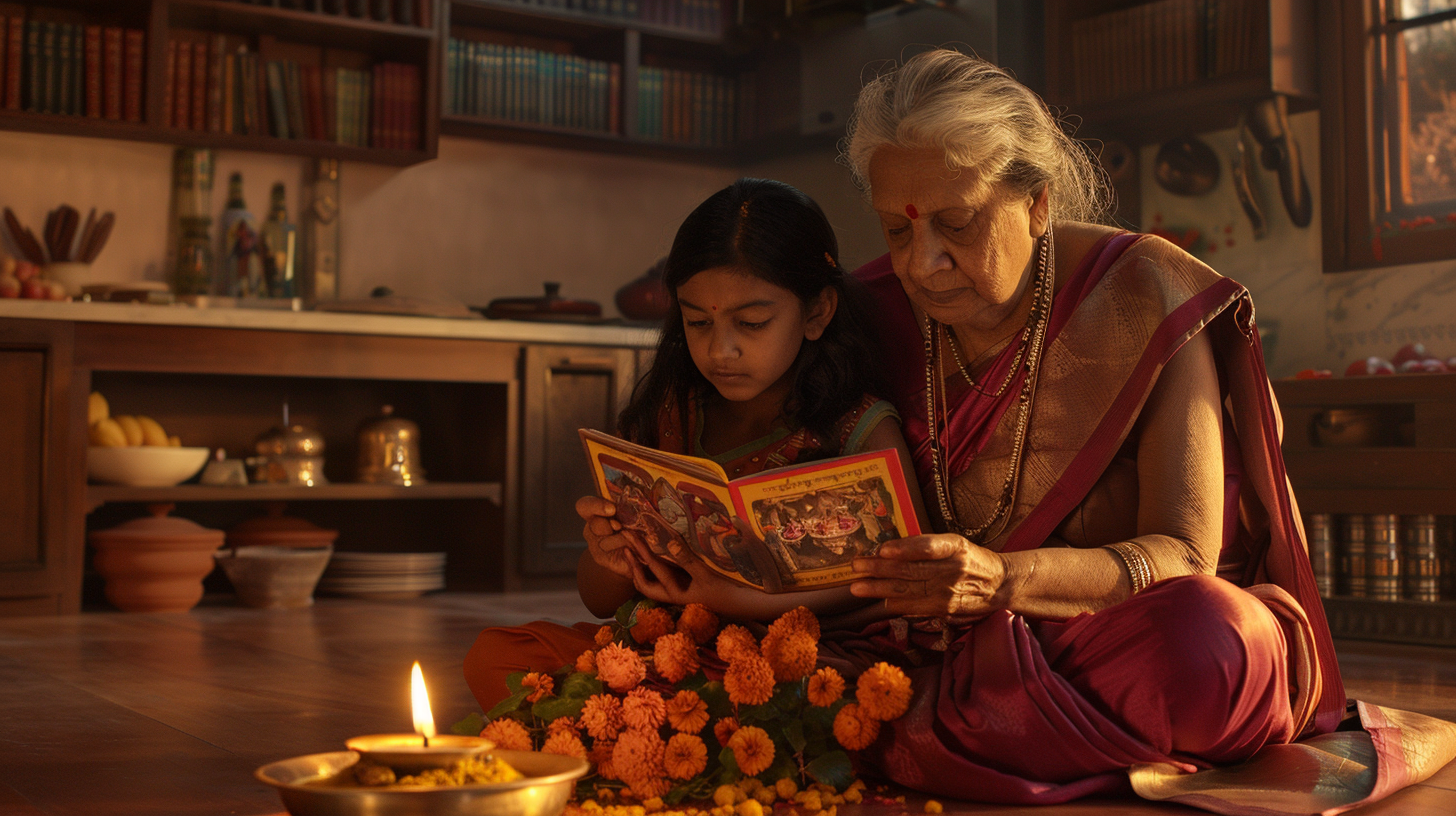
Culture lives in the hands, the nose, the tongue — long before it lives in the mind.
Festivals are the high points of cultural transmission — vivid, joyful, memorable. But culture is also passed in the quieter streams of daily life: in language, in stories, in art, in food. These four areas are where the deepest and most durable transmission happens.
Sanskrit, even in small doses, gives children access to concepts that English simply does not have: dharma, karma, ahimsa, moksha, seva. These are not just words — they are entire philosophies compressed into syllables. A child who knows these words has a vocabulary for the interior life that their English-only peers will spend decades trying to construct. Alongside Sanskrit, the preservation of a regional language — Hindi, Tamil, Telugu, Gujarati, Bengali, Marathi — is one of the most powerful gifts a parent can give. Language carries humor, nuance, poetry, and memory in ways that translation never fully captures.
Start here: Five Sanskrit words per year, learned with their meaning and a story. One regional language conversation per week at dinner. Apps, YouTube channels, and weekend heritage schools can support what you begin at home.
Hindu Hindu Cosmology is one of the world's most sophisticated systems of moral, philosophical, and psychological education — delivered through story. The Ramayana teaches loyalty, duty, and the cost of exile. The Mahabharata teaches the complexity of dharma when competing obligations collide. The stories of the Puranas teach history, cosmology, ecology, and the relationship between the human and the divine. A child steeped in these stories has been given a moral imagination of extraordinary richness — one that will shape how they think, how they judge, and who they become.
Start here: One story per week at bedtime, rotating through the epics and Puranic tales. Amar Chitra Katha for younger children, Devdutt Pattanaik and Bibek Debroy for older ones. After each story, ask: "What would you have done?"
In Hinduism, art is not entertainment — it is sadhana, spiritual practice. Bharatanatyam, Kathak, Odissi, Carnatic music, Hindustani classical — these are disciplines that teach concentration, devotion, embodied knowledge, and the experience of beauty as a path to the sacred. A child who learns even one classical art form carries something that cannot be taken from them — a bodily knowledge of their culture and a connection to a tradition that stretches back thousands of years. They also carry something increasingly rare in American culture: the experience of mastering something ancient and difficult.
Start here: Enroll in classical dance or music classes at your local temple or cultural organization — even one year builds something lasting. Attend performances together. Let your child see masters of their tradition, not just beginners.
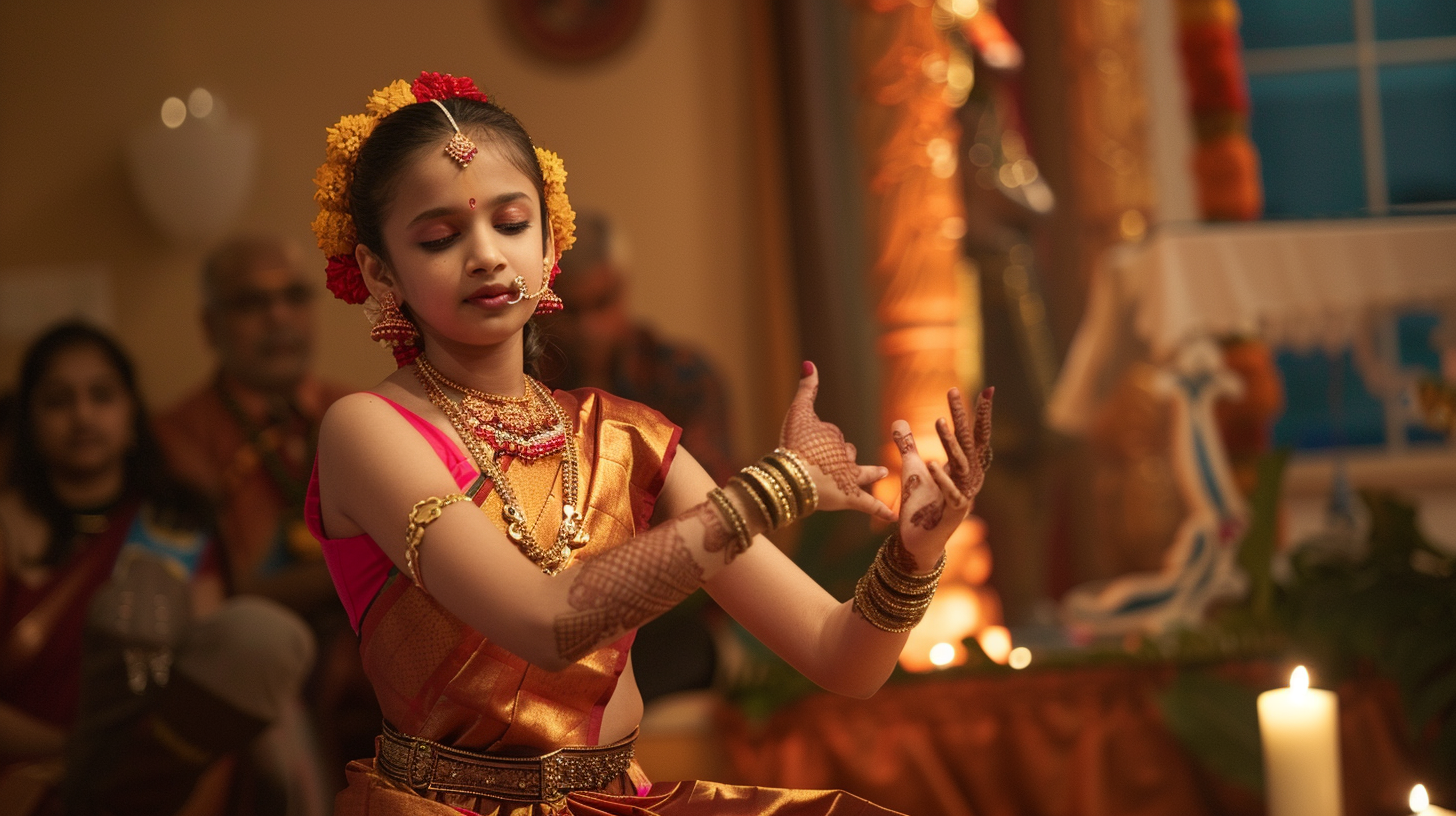
A child who masters a classical art form carries something that cannot be taken from them.
Food memory is among the most durable forms of cultural memory there is. The smell of tadka hitting hot oil, the texture of freshly made roti, the sweetness of kheer on a festival night — these sensory memories wire themselves into the deepest part of a child's brain and resurface, decades later, as the unmistakable feeling of home. Teaching a child to cook the foods of their culture transmits history, geography, regional identity, and love — all through the hands. Every dish has a story: where it comes from, which festival it belongs to, which deity it is offered to, which grandmother first made it this way.
Start here: One cooking session per month tied to an upcoming festival. Let them do as much as safely possible. Tell the story of the dish while you cook. The recipe and the story together are the transmission.
"Culture is not a museum piece to be admired from a distance. It is a living fire — and your job is not to preserve it behind glass but to hand your child a torch."
Raising Dharmic Americans — full series
Part 4 · Now reading
Festivals, language & passing culture forward