
There is a word that many Americans have never heard. A word that describes something millions of Hindu Americans have experienced — in school hallways, in university classrooms, in newsrooms, in the quiet indignity of watching their faith reduced to caricature or their sacred spaces defaced with hateful slogans.
That word is Hinduphobia.
This article is an attempt to explain it clearly — what it is, what it is not, where it shows up, and why it matters. Not as a grievance. Not as an attack on anyone. But as a factual account of something real that deserves to be named, understood, and addressed.
If you are Hindu American, much of what follows will feel deeply familiar. If you are not, we ask only that you read with the same openness you would bring to learning about bias against any other community.
What Is Hinduphobia? A Working Definition
The term Hinduphobia entered broader academic and civic discourse in the early 2000s, though the reality it describes is far older.
The Understanding Hinduphobia Initiative, an academic enterprise dedicated to increasing public consciousness on this issue, defines it as:
“A set of antagonistic, destructive, and derogatory attitudes and behaviors towards Sanatana Dharma (Hinduism) and Hindus that may manifest as prejudice, fear, or hatred.”
The Hindu American Foundation (HAF) describes it more broadly: Hinduphobia and anti-Hindu hatred are fueled by a range of factors, including religious intolerance, a lack of religious literacy, misrepresentation in the media, academic bias rooted in colonial-era misportrayals, and in the diaspora, generalized anti-immigrant xenophobia. Crucially, HAF notes that the existence of Hinduphobia is often denied — and that denial is itself a form of the same prejudice.
Like other forms of religious and ethnic bias — antisemitism, Islamophobia, anti-Christian bigotry — Hinduphobia operates on multiple levels simultaneously. It can be overt, as in physical attacks on temples. It can be institutional, as in biased textbooks. It can be cultural, as in the casual mockery of Hindu practices in mainstream media. And it can be epistemic — the systematic dismissal of Hindu voices and scholarship when they push back against misrepresentation.
Where Hinduphobia Shows Up — Four Key Arenas
1. Temple Vandalism and Physical Attacks
The most visible and visceral form of Hinduphobia in America is the physical desecration of Hindu sacred spaces.
There is a rising spate of hate and violence against Hindus in the US, borne out most visibly in attacks on Hindu temples across the country. Data from the FBI and the California Hate Crimes Hotline validates this troubling trend.
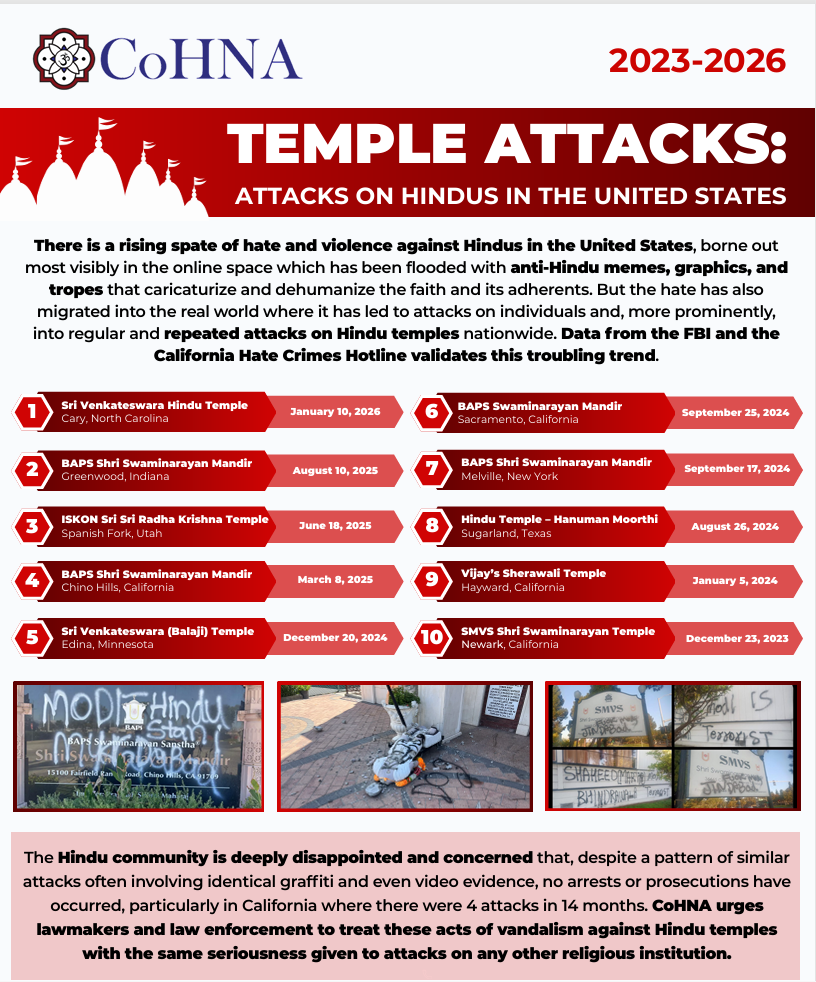
The documented incidents are not isolated. There were 37 instances of anti-Hindu hate crimes reported in 2021 and 2022, with at least three known attacks on Hindu temples in California since December 2023.
In Sacramento, California, a Hindu temple was vandalized for the second time in 10 days on September 26, 2024, with anti-Hindu slogans like “Hindus go back” spray-painted on its walls. In New York, a BAPS Swaminarayan Mandir in Melville was defaced with offensive slogans on September 16, 2024.
Perpetrators have damaged property at mandirs from California to New York, including statues of prominent Hindu figures such as Mahatma Gandhi.
The Congressman’s call to action has been backed by other Indian-American lawmakers, including Ami Bera, Raja Krishnamoorthi, Pramila Jayapal, and Shri Thanedar, who have jointly urged the Department of Justice to address the alarming rise of Hindu hate crimes.
The response from BAPS — whose mandirs have been targeted multiple times — reflects the Dharmic spirit with which the community has met these attacks. Rather than retaliation or rage, BAPS issued what it called an Appeal for Peace, stating: “We also offer our deepest prayers for those who perpetrated this crime to be released of their hatred and to see our common humanity.”
That is not weakness. That is ahimsa — non-violence as a strength that hatred cannot touch.
As Pushpita Prasad of the Coalition of Hindus of North America put it: “Freedom of religion means little when sacred spaces that are meant to be an oasis of peace and calm are vandalized with no consequences.”
2. Bias in K-12 Education
Perhaps the most far-reaching and least discussed form of Hinduphobia in America operates in classrooms — in the textbooks that shape how an entire generation of young Americans understands Hinduism and how Hindu American children understand themselves.
California’s official educational standards contain specific policies asserting that no religious belief or practice may be held up to ridicule and no religious group may be portrayed as inferior. As documented reviews show, the textbooks did not comply with California standards in the case of Hinduism.
California Assemblyman Kevin McCarty, as reported by EdSource during the November 2017 California State Board of Education hearing, stated that middle school texts from major publishers “perpetuate biased themes about Hinduism and Indian culture by utilizing stereotypical images that portray Indians and Hindus as dirty, primitive and ‘spiritually poor’ and failing to provide accurate descriptions and information on Hindu and Jain philosophical and spiritual concepts, teachings and scriptures.”
Islamic, Christian, and Jewish groups have been successfully involved in California’s textbook review process for many years, constantly removing any negative portrayals of their respective religions. The clergy in Islam, Christianity and Judaism are treated as credible experts and their religious texts are assumed to be stating historical facts, while Hindu texts are depicted through pejorative lenses and called “myths.”
A lawsuit filed by California Parents for the Equalization of Educational Materials (CAPEEM) alleged that the state’s history-social science standards negatively portray Hinduism — such as emphasizing its ties to the caste system — while endorsing positive aspects of other religions. Civil rights lawyer Glenn Katon said: “When you teach something so negative like that, and you don’t teach negative things about interpretations of other faiths, that’s a pretty big problem.”
A 2025 peer-reviewed paper in the Journal of the Council for Research on Religion introduced the concept of the “Endogenous Cycle of Hinduphobia” — a theoretical construct explaining the perpetuation of stereotypical depictions and systematic omissions of Hinduism and Hindus in scholarship and media, which seed a biased master narrative about Hinduism in the public imagination. Historical ties of American public education to colonial and missionary objectives are explored, illustrating how curricula have historically undermined Hindu religious and cultural identity by favouring narratives marked by violence, superstition, and moral degradation.
This has a direct, documented impact on Hindu American children. In 2016, Hindu American students addressed the California Department of Education directly, describing the detrimental effects of these educational biases on their individual and collective identities. These are children telling adults: what you are teaching about my faith is wrong, and it is hurting me.
3. Bias in Media and Popular Culture
When Hinduism appears in mainstream American media, it is too often reduced to a punchline, an exotic backdrop, or a list of its most complex social challenges — without context, without nuance, without the 5,000-year civilization behind it.
Hindu deities are commodified on clothing, yoga mats, and Halloween costumes without understanding or respect. Practices rooted in deep spiritual tradition are mocked in television comedies. The faith of 1.2 billion people worldwide is routinely treated as one of the least deserving of serious, respectful engagement.
In American academia, Hindus are shown in a bad light, as texts portray them as hierarchical and oppressive. Even in sixth-grade school textbooks, Hindus are shown in a narrow sense.
A young Hindu woman interning for NASA was subjected to Hinduphobia when she posed in a picture with images of Hindu deities on her desk. She was attacked for merely expressing her heritage, with comments such as: “I see a right wing Hindu kid with right wing Hindu gods in a pic” and “Wherever Hindus will go they will divide the nation into caste.”
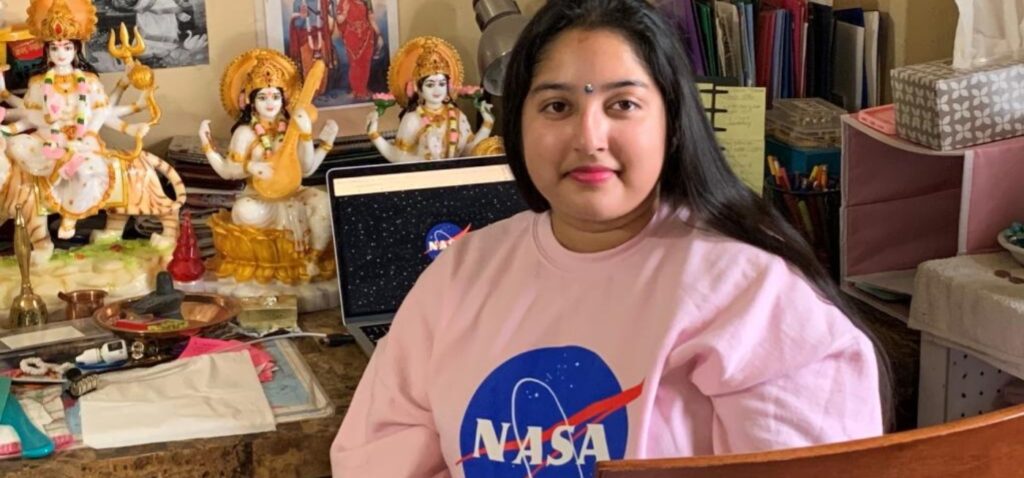
This is what Hinduphobia looks like in everyday American life. Not always a hate crime. Sometimes just a comment. But comments accumulate. They shape how a child sees themselves. They determine whether a Hindu American feels free to express their identity — or feels compelled to hide it.
4. Erasure and Denial in Academia
Academic bias rooted in oftentimes racist, colonial-era misportrayals continues to fuel Hinduphobia today. Worse yet, the existence of Hinduphobia and anti-Hindu hatred is often denied — which itself is a form of the same prejudice.
This academic dimension of Hinduphobia is particularly insidious because it operates under the authority of scholarship. When a university course presents Hinduism primarily through the lens of caste oppression, colonial critique, or political controversy — without equivalent scrutiny of other world religions — it creates a distorted picture that students carry into their careers, their writing, and their policymaking.
Despite Hindu Americans being mostly well-educated — doctors and engineers, scientists and technologists, entrepreneurs and professors — the Hindu is relentlessly portrayed in academia and the media as an existential threat to others.
The Understanding Hinduphobia Initiative, led by Dr. Indu Viswanathan of Teachers College, Columbia University, has done important work to document and analyze this pattern — bringing academic rigor to what Hindu Americans have long known from lived experience.
Shree Rajiv Malhotra — The Intellectual Kshatriya Who Named the Problem
No discussion of academic Hinduphobia would be complete without acknowledging the man who has done more than perhaps anyone else to document, analyze, and challenge it from within the American intellectual landscape.
Shree Rajiv Malhotra is an Indian-born American author, researcher, and public intellectual based in Princeton, New Jersey. Trained originally as a physicist and computer scientist, he built a successful corporate career before founding Infinity Foundation in Princeton in 1994 — a nonprofit dedicated to research on civilizations, cross-cultural encounters, and the place of Indic knowledge in the modern world. Infinity Foundation has given more than 400 grants for research, education, and community work, and has published a landmark 14-volume series on the History of Indian Science and Technology.
What makes Rajiv Malhotra’s contribution singular is not just the breadth of his scholarship — it is his willingness to directly confront the academic establishment in the United States that has, for decades, shaped how Hinduism is taught, studied, and understood in the West.
He has been described as an Intellectual Kshatriya — a warrior whose weapons are words, research, and relentless intellectual rigor. That description is apt.
Key Contributions and Ideas:
The Term “Hinduphobia” Itself Rajiv Malhotra is widely credited with popularizing the term Hinduphobia and bringing it into mainstream discourse. Phrases like Breaking India, Indian Grand Narrative, Hindu Open Architecture, Digestion, History-Centrism, and Hinduphobia have been coined or popularized by him and are now part of the vocabulary of Dharmic discourse worldwide.
Invading the Sacred (2007) This landmark book — in which Malhotra is the central protagonist — is a comprehensive critique of the Freudian psychoanalytical treatment of Hinduism by certain Western academics, particularly within the American Academy of Religion (AAR). The book documented how a powerful academic network was producing scholarship that portrayed Hindu deities, practices, and texts in deeply distorted, often sexualized terms — under the banner of serious scholarship. It gave the Indian American diaspora the language and the evidence to recognize this pattern and push back. As one reviewer noted, it is “perhaps one of the most definitive works that aid our understanding of the exact state of affairs in Indology in US academia.”
Academic Hinduphobia (2016) In this pointed and extensively researched volume, Malhotra directly critiques what he calls the “Erotic School of Indology” — a strand of academic scholarship that reduces the depth and richness of Hindu texts, deities, and traditions to narrow psychoanalytic and sexualized interpretations. He introduces the concept of Atrocity Literature — his term for mass-produced academic content that characterizes Hindus as misogynists, oppressive, irrational, violent, and debauched. As the book documents, Indian culture is reduced in this literature to what Malhotra memorably calls “cows, caste, curry, sati and dowry” — a reductive caricature presented as scholarship.
Being Different (2011) In Being Different, Malhotra makes a philosophical case for what he calls Purva Paksha — the Hindu tradition of deeply and honestly engaging with an opposing viewpoint before responding to it. He argues that the West has largely failed to do this with Hinduism — projecting its own categories, assumptions, and frameworks onto a civilization that operates on fundamentally different metaphysical premises. The result is not understanding but distortion.
The Concept of “Digestion” One of Malhotra’s most important and original intellectual contributions is the concept of Digestion — the process by which elements of Hinduism (yoga, meditation, Ayurveda, Sanskrit concepts) are absorbed into Western culture while being stripped of their Dharmic roots, repackaged in Western frameworks, and presented as having no Hindu origin. The result is a culture that benefits enormously from Hindu wisdom while simultaneously dismissing or denigrating the civilization that produced it. This concept has become essential vocabulary for anyone thinking seriously about cultural appropriation and intellectual property in the context of Dharmic traditions.
The Battle for Sanskrit (2016) This book challenges Western Indological scholars who treat Sanskrit as a dead language — a museum piece like Latin — rather than the living, sacred language it remains for hundreds of millions of Hindus. Malhotra argues that this framing is not neutral scholarship but an act of intellectual colonialism that erases the spiritual dimension of one of humanity’s greatest linguistic and philosophical traditions.
Infinity Foundation’s Broader Mission Beyond his books, Infinity Foundation has funded and promoted a generation of scholars working to produce Dharmic-centered research on Indian history, philosophy, science, and culture. Malhotra also serves as Chairman of the Board of Governors of the Center for Indic Studies at the University of Massachusetts, Dartmouth, and as a visiting professor at Jawaharlal Nehru University. His YouTube channel has attracted over 73 million views and 569,000 subscribers — a measure of how hungry the Hindu American community is for exactly this kind of informed, fearless intellectual engagement.
Rajiv Malhotra’s work is not without its critics — significant intellectual work rarely is. But his contribution to the Hindu American community’s ability to understand, articulate, and defend its civilizational identity is difficult to overstate. He has given the community a vocabulary, a framework, and a body of evidence. He has shown that Hinduism can be defended not just with devotion but with scholarship — not just with faith but with facts.
In the language of the Gita: he has done his dharma. Fearlessly, relentlessly, and without attachment to approval.
What Hinduphobia Is Not
An honest explainer must also address what this term does not mean — because clarity matters and the conversation deserves it.
Hinduphobia is not a shield against legitimate critique. Hinduism, like every living tradition, has social dimensions that invite honest scholarly and public examination — caste discrimination, gender inequality, and political co-option among them. Documenting or critiquing these is not Hinduphobia. The distinction lies in standard, context, and intent: applying a standard of scrutiny to Hinduism that is not applied equally to other faiths, or using legitimate social critique as a vehicle for wholesale dehumanization of Hindu identity, crosses the line.
Hinduphobia is not about politics. Anti-Hindu bias is a question of religious freedom and civil rights — not a proxy for any political agenda. Hindu Americans span every point on the political spectrum. The community’s concern about bias in textbooks, temple attacks, and media misrepresentation is a civil rights concern, not a partisan one.
Naming Hinduphobia is not the same as claiming victimhood. It is the same act of clarity and self-advocacy that every other community has exercised when facing bias. Naming something is the first step toward addressing it — and Hindu Americans have every right to name what they experience.
The Community’s Response — Facts, Dignity, Strength
What is most striking about the Hindu American community’s response to Hinduphobia is its character.
At vandalized temples, communities gather not in rage but in prayer. BAPS prays for the perpetrators. The Coalition of Hindus of North America calls for accountability through law. The Hindu American Foundation submits academically vetted textbook corrections and files civil rights complaints.
This is a community that meets bias with Dharma — with the conviction that truth, spoken clearly and persistently, is stronger than hatred.
HAF has worked with academics and educators to provide edits and corrections to California textbooks, supporting only academically-vetted submissions by leading academics of religion and history that addressed inaccuracies, brought parity to the way Hinduism is taught in contrast to other religions, and reflected modern scholarship.
These are not the actions of a community in retreat. They are the actions of a community that knows its worth, knows its history, and is committed to ensuring that the next generation of Hindu Americans — and the next generation of all Americans — has access to an accurate, dignified, and complete understanding of one of humanity’s oldest living traditions.
What Every American Can Do
Hinduphobia, like all forms of religious and ethnic bias, is not only a Hindu American problem. It is an American problem — a challenge to the foundational commitments of pluralism, religious freedom, and equal dignity that this nation was built to uphold.
Here is what any American can do:
- Learn. Visit a Hindu temple. Attend a festival. Read about Sanatana Dharma from sources written by Hindus, not only about Hindus by outsiders.
- Listen. When Hindu Americans describe their experiences of bias, extend the same good faith you would to any other community.
- Speak up. When you see Hinduism mocked, stereotyped, or misrepresented — in a classroom, a newsroom, or a comment section — say something.
- Support. Organizations like the Hindu American Foundation, the Coalition of Hindus of North America (CoHNA), and the Understanding Hinduphobia Initiative are doing the hard, necessary work of documentation and advocacy.
A Final Word
Hinduism has survived for more than five thousand years. It has outlasted empires, colonialism, partition, and persecution. It carries within it a philosophy deep enough to answer the hardest questions human beings face — about suffering, about meaning, about how to live with integrity in a complicated world.
Hindu Americans did not bring a fragile faith to this country. They brought one of the most resilient, sophisticated, and life-affirming spiritual traditions in human history.
Hinduphobia cannot diminish that. But it can harm real people — real children in real classrooms, real families in real temples. And that harm deserves to be seen, named, and addressed.
DharmikAmerica.com exists, in part, for exactly this purpose.
We will keep documenting. We will keep speaking. And we will do it the Dharmic way — with facts, with dignity, and with the unshakeable conviction that truth always prevails.
Satyameva Jayate. Truth alone triumphs.

Resources & Organizations
- Hindu American Foundation — Hinduphobia — documentation, advocacy, civil rights
- Coalition of Hindus of North America (CoHNA) — resources and incident tracking
- Understanding Hinduphobia Initiative — academic research and working definition
- CoHNA — Attacks on Hindu Temples in the US — documented incident timeline
- Rajiv Malhotra — rajivmalhotra.com — books, essays, and research on academic Hinduphobia and Indic civilization
- Infinity Foundation — grants, research, and Indic scholarship
- Infinity Foundation YouTube — 73M+ views of lectures, debates, and civilizational discussions
Have you or someone you know experienced Hinduphobia? Use our Speak Up page to share your story. Your voice matters — and your experience deserves to be heard.
DharmikAmerica.com — Dharmik Life. American Soul.