
Sacred Ground: The Story of Hindu Temples in America
From a San Francisco storefront in 1906 to over 1,000 mandirs nationwide - how Hindu temples took root and flourished across the United States.
Every Hindu temple in America tells a story. A story of families gathered in living rooms because there was nowhere else to go. Of a granite Ganesha statue carried across the ocean because someone believed it was a good omen for something larger.
Today, there are more than 1,000 Hindu temples in the United States. They rise from the plains of Texas and the hills of West Virginia. They anchor immigrant communities in Queens, Silicon Valley, and suburban New Jersey. They welcome millions of visitors — Hindu and non-Hindu alike — every single year.
This is the story of how they got here.
The Seed Is Planted
Before there were Hindu temples in America, there was a voice. When Swami Vivekananda stepped onto the stage at the Parliament of the World's Religions in Chicago in September 1893 and opened with "Sisters and brothers of America," he planted the institutional seed from which American Hindu life would eventually grow.
Following his electrifying reception, Vivekananda established Vedanta Societies in New York City and San Francisco in the 1890s — the first formal organizational homes for Hindu philosophy in America. The Vedanta Society of San Francisco built the first Hindu temple in the West in 1906, under the leadership of Swami Trigunatita — a direct disciple of Sri Ramakrishna. The building survived the catastrophic 1906 earthquake. More than a century later, it still stands.
The Doors Open
The Immigration and Nationality Act of 1965 transformed the United States. Indian professionals arrived in waves: doctors, engineers, scientists, academics. They brought their faith. And almost immediately they began to ask: Where do we worship?
Meanwhile, in a small storefront at 26 Second Avenue in New York City, a 69-year-old Swami from Calcutta was launching a movement. A.C. Bhaktivedanta Swami Srila Prabhupada founded ISKCON in 1966, carrying the message of Lord Krishna from India to the West. He arrived with almost nothing. He chanted the Hare Krishna mahamantra in Tompkins Square Park with young Americans who had never heard it before. Within years he had a movement.
In 1968, under Srila Prabhupada's direct guidance, New Vrindaban was founded in Marshall County, West Virginia — 1,204 acres named for the sacred land where Lord Krishna spent his childhood. America's first intentional Hindu spiritual community, planted in the Appalachian hills.
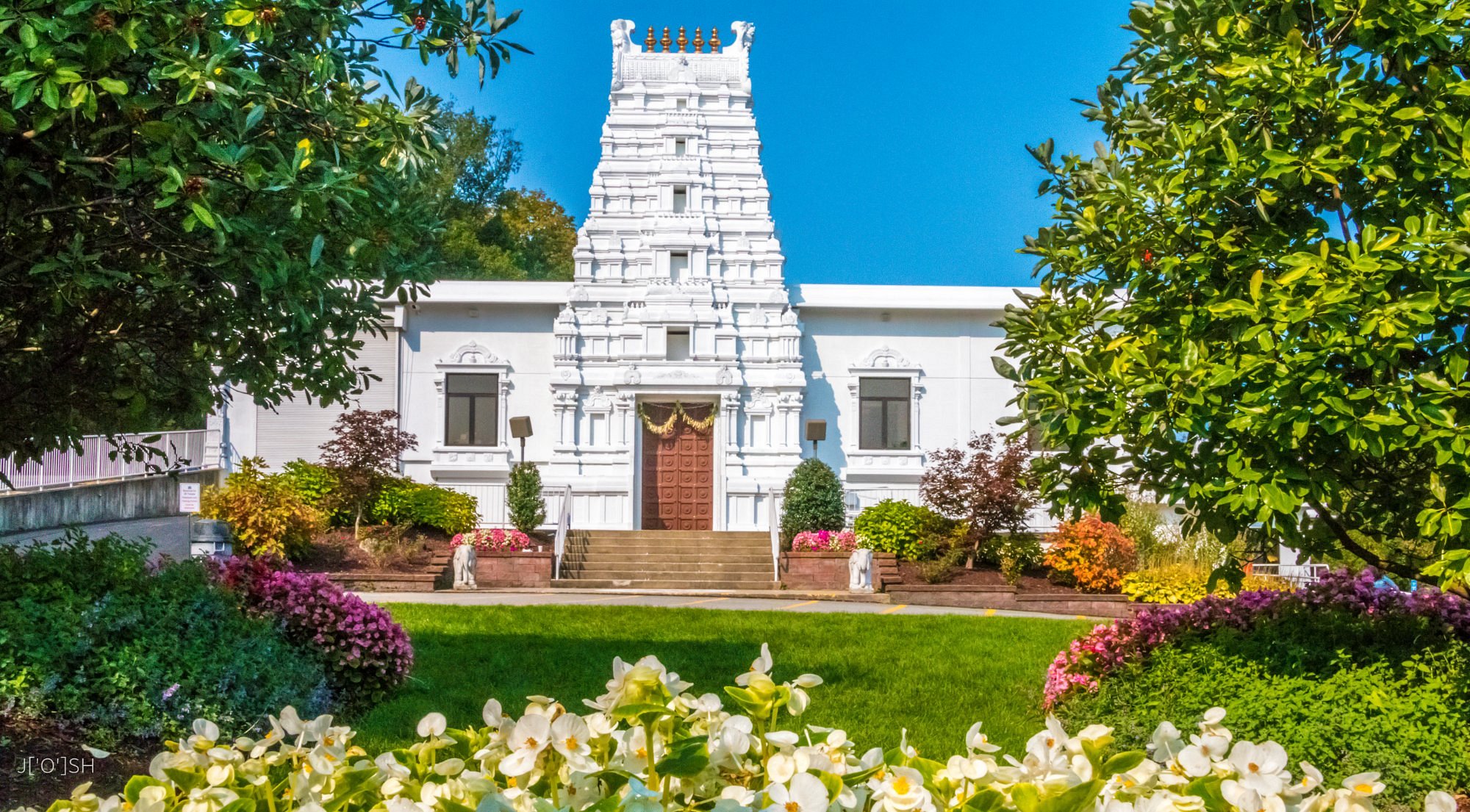
Sri Venkateswara Temple, Pittsburgh
1977 · Penn Hills, PennsylvaniaIn the summer of 1972, a group of South Indian academics gathered in a Pittsburgh grocery store basement for Pongal. Someone donated a granite Ganesha statue. By 1977 — the oldest traditional Hindu temple built by Indian immigrants in the United States was complete in Penn Hills.
15 sculptors and an architect arrived from India, following specifications from ancient sacred texts. The project was partially funded by the Tirumala Tirupati Devasthanams (TTD) — the ancient temple trust in Andhra Pradesh. A nuclear engineer named Dr. Raj Gopal had the vision. The community built the temple. Tens of thousands of pilgrims visit annually from across North America.
Visit svtemple.org →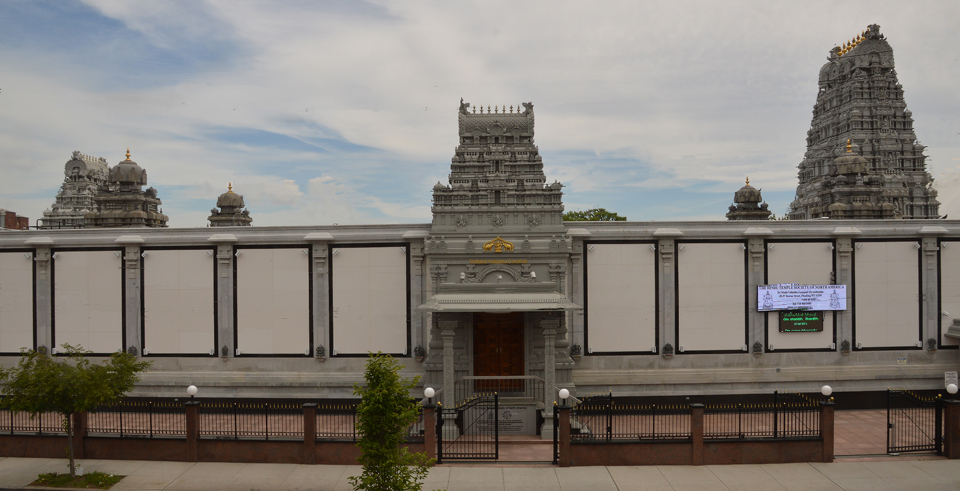
The Ganesh Temple, Flushing, Queens
1977 · New York CityThree weeks after Pittsburgh, on July 4, 1977 — the Ganesh Temple in Flushing, Queens was consecrated. The community had gathered since 1970, purchasing land from a Russian Orthodox church that had moved. Today the Sri Maha Vallabha Ganapati Devasthanam is the second-oldest Hindu temple in the United States built by Indian immigrants.
Its South Indian gopuram rises magnificently from a residential block in one of the most diverse neighborhoods on earth — beside Korean churches, Chinese Buddhist temples, and a Sikh gurdwara. Not an anomaly. An equal.
Visit nyganeshtemple.org →The Movement Grows
The twin inaugurations of 1977 set off a temple-building wave that would not slow for decades. Through the 1980s and 1990s, Hindu communities in every major American city followed the same arc: living rooms → community halls → converted buildings → purpose-built mandirs.
ISKCON expanded dramatically. The largest ISKCON temple in the United States opened in Los Angeles — New Dwarka. New Raman Reti in Alachua, Florida became a devotional community of over 450 families on 127 acres. South Indian temple traditions expanded with particular energy — Venkateswara temples, Murugan temples, Shiva temples built in the Agamic style — reflecting the demographics of the first immigrant wave.
Sri Venkateswara Temple, Bridgewater, New Jersey
1998 · Bridgewater, New JerseyNew Jersey is home to one of the largest Hindu American populations in the country. The Balaji Mandir — inaugurated through the sacred Kumbhabhishekam ceremony in 1998 — was designed by Indian Temple Architects (Sthapati) according to ancient building codes. Nine years of community fundraising preceded it.
The temple features 16 shrines, including Sridevi, Bhudevi, Ganesha, and Lakshmi. A South Indian cafeteria serves dosa, idli, and vada. On festival days, thousands gather from across the tri-state area. On weekday mornings, Nitya Aaradhana prayers are performed exactly as they would be at Tirupati in India.
Visit venkateswaratemple.org →
ISKCON New Vrindaban — Palace of Gold
1968 · Moundsville, West VirginiaOne of the most extraordinary sacred spaces in the United States — 1,204 acres in the Appalachian hills of West Virginia, named for Krishna's childhood land. The Palace of Gold features elaborate gold leafwork, stained glass windows, and hand-carved teakwood — built almost entirely by ISKCON devotees with no formal construction training.
Gopal's Garden School offers pre-K through 10th grade. Govinda's restaurant draws visitors from across the country to vegetarian cuisine in rural Appalachia. ISKCON did not retreat into an ethnic enclave. It engaged America — with devotion, prasadam, and an open door.
Visit newvrindaban.com →The mandir did not just preserve their faith in America. In many ways, it preserved them.
The Thousand Mandirs
The turn of the millennium marked a new phase. The first generation had built their temples. Now their children — American-born — were inheriting them, and transforming them. The number of Hindu temples in the US grew from 435 to over 1,000 in just twenty years.
New traditions found their American home: the Chinmaya Mission with over 70 North American centers, the Mata Amritanandamayi Mission drawing thousands to Amma's ashram in San Ramon, California, and Arsha Vidya and Advaita Vedanta organizations offering serious philosophical study. Each brought a different dimension of Sanatana Dharma to American soil.
The BAPS Swaminarayan Akshardham in Robbinsville, New Jersey — completed in 2023, the second-largest Hindu temple in the world — represents the apex of this ambition. But it is not alone. Across the country, Hindu communities have invested in expansion, renovation, and new construction at a pace that reflects both growing numbers and growing confidence.
The doors are open. Whoever sincerely offers their prayers will attain happiness and peace.
DharmikAmerica.com Dharmik Life, American Soul