
Swastika vs. Hakenkreuz: Reclaiming a Sacred Symbol Without Erasing a Tragedy
How a 11,000-year-old symbol of well-being was hijacked by hatred — and why telling the two apart honors both Hindu tradition and Jewish memory.
Two Symbols, One Confusion
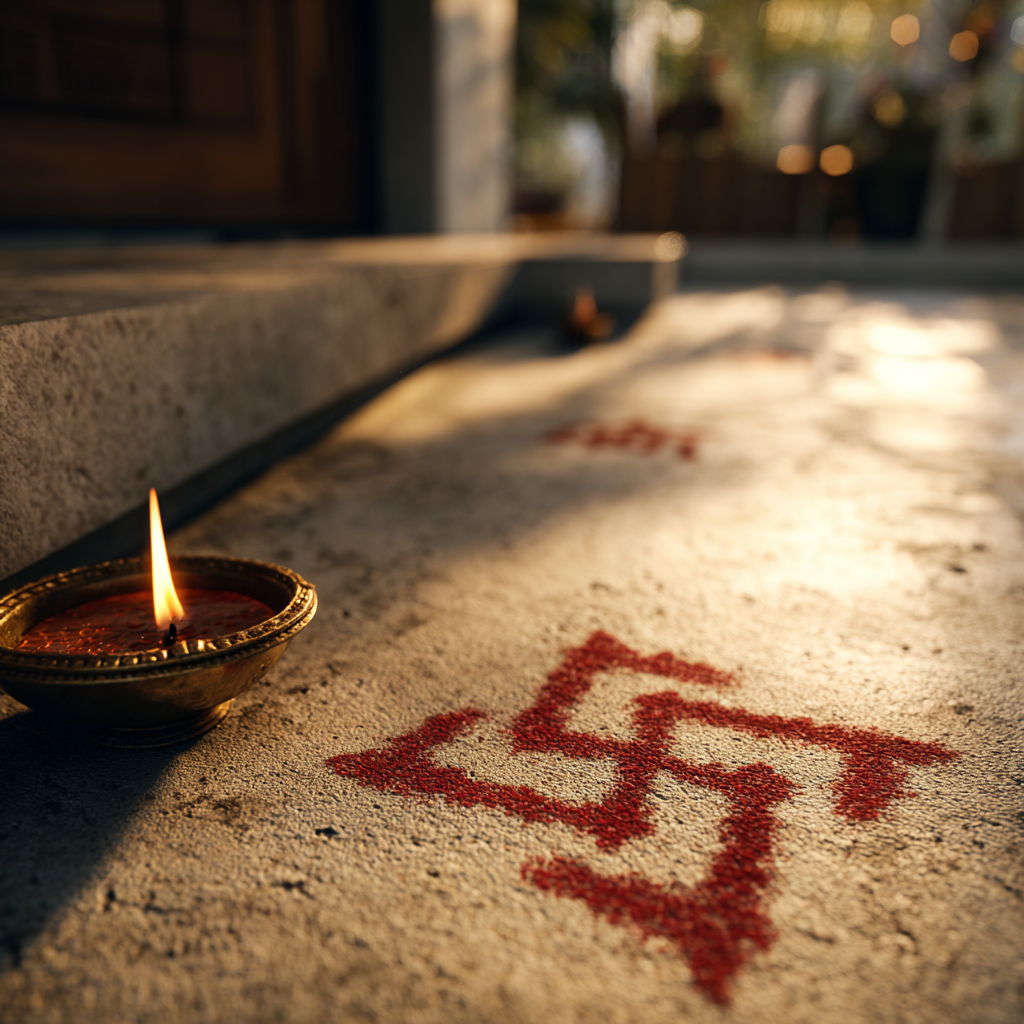
Walk into a Hindu wedding, a Jain temple, or a Diwali celebration in America, and you'll likely see it: a small cross with four bent arms, often drawn in red or gold, marking a doorway, an account book, or a ritual offering. To the family drawing it, this symbol means well-being and good fortune — exactly what it has meant for thousands of years, long before anyone in Europe had heard the word "Aryan."
But to a neighbor glancing through the window, that same shape can trigger alarm, because the only version most Americans have ever been taught to recognize is the one stamped on Nazi flags and armbands.
This is the confusion at the heart of one of the most painful cross-cultural misunderstandings in American life. Two visually similar symbols — one sacred and ancient, one manufactured and genocidal — have collapsed into a single mental image for most people raised in the West. That collapse causes real harm on both sides: Hindu, Jain, Buddhist, and Zoroastrian families face suspicion and even legal jeopardy for practicing their own faith, while Jewish families are forced to relive Holocaust trauma every time the symbol appears, without always knowing which version they're looking at.
This article is not about minimizing the Holocaust. It's about getting the history right — because historical accuracy protects both communities. The clearer we are about what the Swastika has meant for five millennia, and what the Nazis specifically built to weaponize it, the better equipped everyone is to tell the two apart, and to know exactly which one deserves permanent rejection.
What the Swastika Actually Is
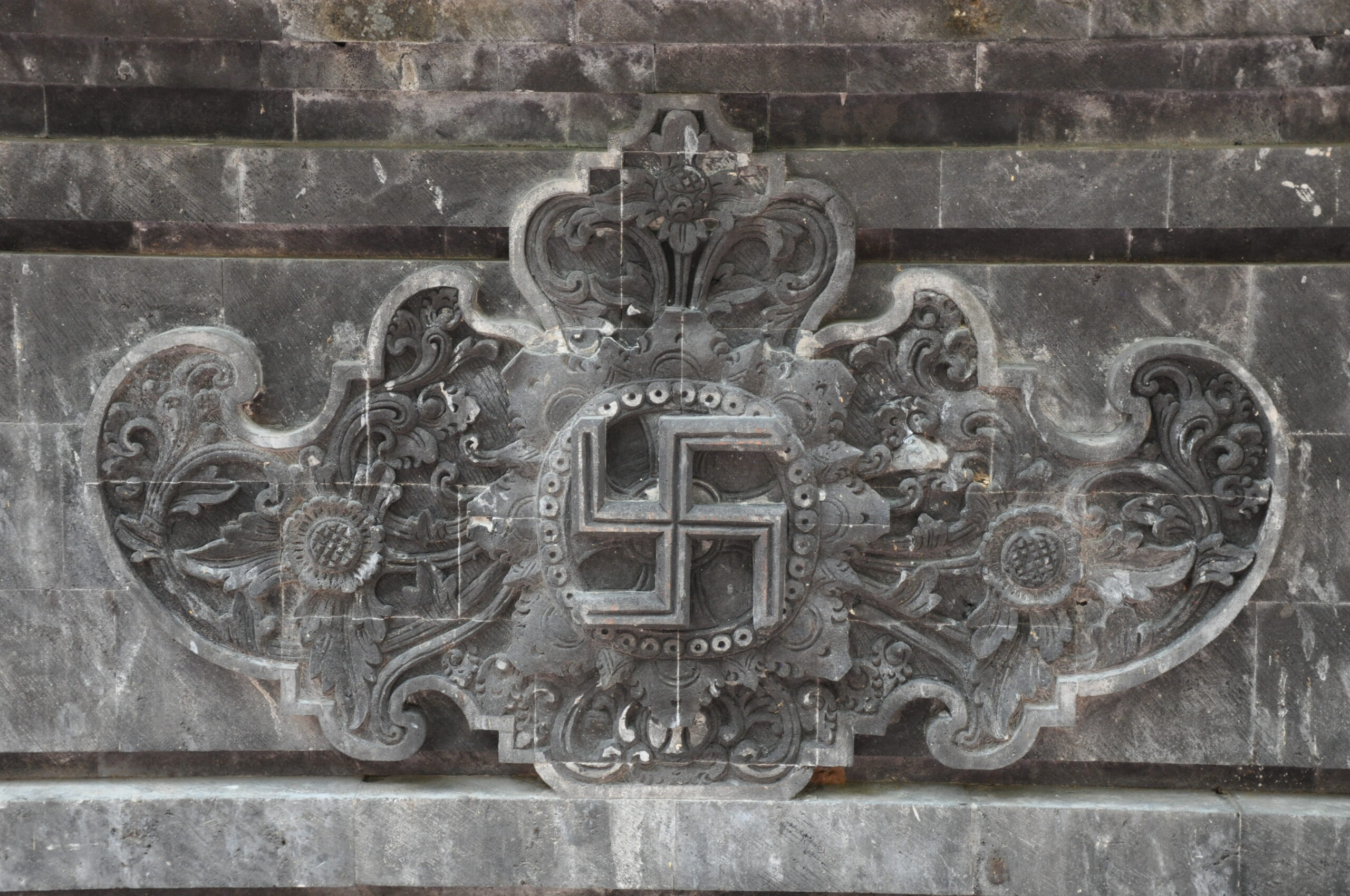
The word "Swastika" comes from Sanskrit — su, meaning good or auspicious, combined with asti, "it is." Together: "that which is good," or "may all be well." It's not a borrowed word or retrofitted meaning; it's the symbol's original name in its original language.
Archaeologists trace Swastika-like markings back at least 11,000 years across Eurasia, appearing on Indus Valley artifacts more than a thousand years before the Vedic period. Long before it belonged to any single religion, the shape appeared independently among ancient Greeks, Celts, Native American nations, and early Byzantine Christians, who called it the gammadion cross. It shows up on Roman mosaics, Persian textiles, and Mayan carvings — one of the most universal geometric symbols humans have ever created, worth remembering whenever someone insists it "belongs" to one chapter of the twentieth century.
Within Hinduism, Jainism, and Buddhism, it carries layered meaning. Hindus and Jains use it to mark the opening pages of account books during Diwali (Chopda Pujan), as well as thresholds, doors, and offerings. The right-facing, clockwise Swastika is associated with the sun and Vishnu; the left-facing form — more precisely the sauvastika — with night and Goddess Kali. In Jain iconography, the four arms represent the four states of worldly existence, crowned by three dots symbolizing right faith, knowledge, and conduct. In Buddhism, it marks the beginning of sacred texts and represents harmony and the eternal dharma. This is living practice today, carried out by well over a billion people, exactly as it has been for millennia.
How the Nazis Built the Hakenkreuz
To understand how a symbol of peace ended up on a flag tied to genocide, you have to follow a specific chain of events — starting with a distortion of scholarship, not religion.
In the 18th and 19th centuries, European linguists discovered structural links between Sanskrit and European languages, leading to the hypothesis of a shared ancestral "Aryan" people. This began as linguistics, but nationalist and racial theorists hijacked it into a claim of racial descent. Archaeologist Heinrich Schliemann, excavating ancient Troy, found Swastika motifs on pottery and helped popularize the symbol as supposed evidence of "Aryan" heritage. The actual religious meaning didn't survive this transformation — only the shape did, refilled with an invented racial mythology. By the time a small nationalist party in post-WWI Germany looked for a unifying emblem, several völkisch and far-right groups had already adopted Swastika-like symbols as markers of "pure" Germanic identity. The Nazi Party wasn't first, but it formalized and legally codified this racialized version.
Hitler personally finalized the design in 1920, adopted officially at the Salzburg Congress that August. It wasn't simply "a Swastika" — it was a specific, engineered graphic: a black hooked cross, tilted 45 degrees, inside a white circle, on a red field. Hitler explained the symbolism in Mein Kampf: red for the movement's social vision, white for German nationalism, the black hooked cross for the struggle for Aryan racial victory. The 45-degree tilt was deliberate — distinct from the flat, static orientation typical in religious use — meant to suggest forward motion and aggression.
The design wasn't left informal. The exact proportions, angle, and placement were locked into German law through the 1935 Reich Flag Law, passed the same year as the Nuremberg Laws that stripped Jews of citizenship. What had been an open, universal symbol of goodwill became, by law, the fixed emblem of a genocidal regime.
This is why the correct name for the Nazi symbol is hakenkreuz — German for "hooked cross," a distinct term for a distinct, purpose-built design. The traditional Swastika in Hindu, Jain, and Buddhist practice is typically flat-sided rather than tilted, often accompanied by dots or a border, and can face either direction depending on tradition. The Nazis didn't rediscover an ancient symbol — they engineered a new one using an old one's silhouette, then wrote its meaning into law by force.
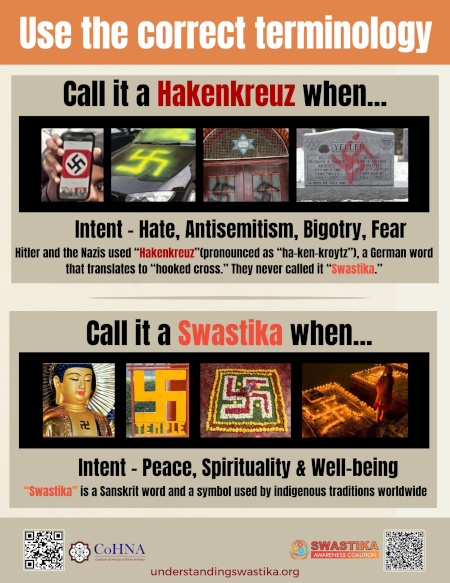
The correct name for the Nazi symbol is hakenkreuz (hooked cross) — a specific, legally codified 20th-century design, not simply "the Swastika."
Standing With Our Jewish Brothers and Sisters
None of this history changes one fact: the Holocaust was one of the greatest atrocities in human history. Six million Jews were murdered by the Nazi regime, alongside millions of Roma, disabled people, and political prisoners. The hakenkreuz flew over that machinery of murder. For Jewish families today — including survivors and their descendants — the sight of that symbol is not an abstract reference. It is a direct link to genocide, and that reaction deserves respect, not argument.
Dharmic tradition gives Hindu Americans strong grounding for standing firmly with the Jewish community here. Ahimsa — non-harm — sits at the center of Hindu, Jain, and Buddhist ethics. So does vasudhaiva kutumbakam, the idea that the whole world is one family. Reclaiming a symbol's true meaning and condemning the horror committed under its distorted twin aren't competing goals — they flow from the same values.
This isn't just theoretical. The Hindu American Foundation, the American Jewish Committee, and the Interfaith Conference of Metropolitan Washington jointly produced an educational guide, Swastika: Use and Abuse of a Sacred Symbol, built to explain the symbol's ancient meaning for Hindus, Jains, Buddhists, and Zoroastrians while honoring the painful weight the Nazi symbol carries for Jewish communities — both goals held together, not traded off. AJC's own interreligious leadership has called this kind of joint work a genuinely remarkable moment in American interfaith relations.
That relationship shows up in everyday community life, too — Hindu and Jewish organizations have held joint celebrations marking Janmashtami and Rosh Hashanah together. And it runs in both directions during crisis: after the Hamas terror attacks, Hindu American organizations publicly condemned the violence and antisemitism in all forms, showed up at Jewish solidarity events, and expressed gratitude for Jewish support in fighting anti-Hindu bigotry. Jewish organizations, in turn, have written publicly about standing with Hindu Americans against prejudice, pointing to moments when Indian Americans showed up for the Jewish community during earlier antisemitic incidents.
Reclaiming the Swastika's true meaning and standing against antisemitism aren't two separate projects. They are, and should be, the same project.
The Legal and Policy Tangle

Because the hakenkreuz became the emblem of a genocidal regime, many countries restrict its public display — reasonably so. Germany's criminal code, Switzerland's 2024 law, and Australia's 2024 federal ban all prohibit Nazi symbols. The trouble is that a law banning "the Swastika" without precision risks sweeping up millennia-old religious practice along with it — and in documented cases, it has.
Some jurisdictions build in careful distinctions. Germany, Austria, and Switzerland include exceptions for religious, historical, or educational use. Australia's 2024 law was explicitly written to criminalize the Nazi hakenkreuz while excluding Hindu and other religious versions — a template worth following elsewhere.
Not every effort has been this careful. In 2007, when Germany pushed for an EU-wide ban on Nazi symbols, Hindu communities across Belgium, France, Italy, the Netherlands, and the UK organized to warn that an undifferentiated ban would criminalize their own religious practice. The Hindu Forum of Britain made a comparison worth sitting with: the KKK's misuse of burning crosses in America never led to a call to ban crosses from churches; one movement's appropriation of the Swastika shouldn't erase millennia of religious use elsewhere.
The clearest example of getting this right comes from California. In 2022, the state legislature passed AB 2282, making California the first state to explicitly recognize the Swastika as a sacred symbol of peace within Hinduism, Buddhism, and Jainism directly in its penal code — while separately naming the Nazi symbol by its accurate term, the hakenkreuz. The bill's path to passage shows how much precision matters: the Coalition of Hindus of North America and its Hindu, Buddhist, and Jain partners pushed hard during drafting to strip phrases like "Nazi Swastika" from the bill's language entirely, insisting that even a protective bill shouldn't reinforce the false conflation it aimed to correct. Assemblymember Rebecca Bauer-Kahan, who authored the bill with the Hindu American Foundation, put the history plainly: Hitler and the Nazi regime stole a symbol that had represented peace for thousands of years and turned it into a banner of hate.
The bill followed real incidents, including a Hindu family threatened with fines by their own homeowners' association for displaying a religious Swastika at their entrance. AB 2282 passed the California Senate unanimously — a rare point of consensus showing this is a solvable problem of legal precision, achievable without diminishing protection from actual hate symbols.
How Hindu Americans Can Talk About This — Practically

For Hindu American families raising children here, this topic eventually comes up. A few principles help:
- Lead with context, not defensiveness. Acknowledge why the assumption exists — most Americans were simply never taught the symbol's other meaning.
- Separate the two symbols by name. Using "hakenkreuz" for the Nazi emblem, distinct from "Swastika," gives people accurate vocabulary instead of one word carrying two meanings.
- Don't ask anyone to get over their reaction. Jewish friends and neighbors aren't being unreasonable when they feel uneasy seeing the shape. The goal isn't to argue someone out of a legitimate, historically grounded fear — it's to add information alongside it, gently.
- With children, avoid both shame and defensiveness. Kids need a simple, honest framework: this symbol has meant something good in our family's tradition for thousands of years; a cruel government twisted its shape into something evil; both things are true.
- Lead with shared values, not just shared history. Conversations built around ahimsa and universal kinship tend to land better than ones built purely on grievance.
Reclaiming Without Erasing
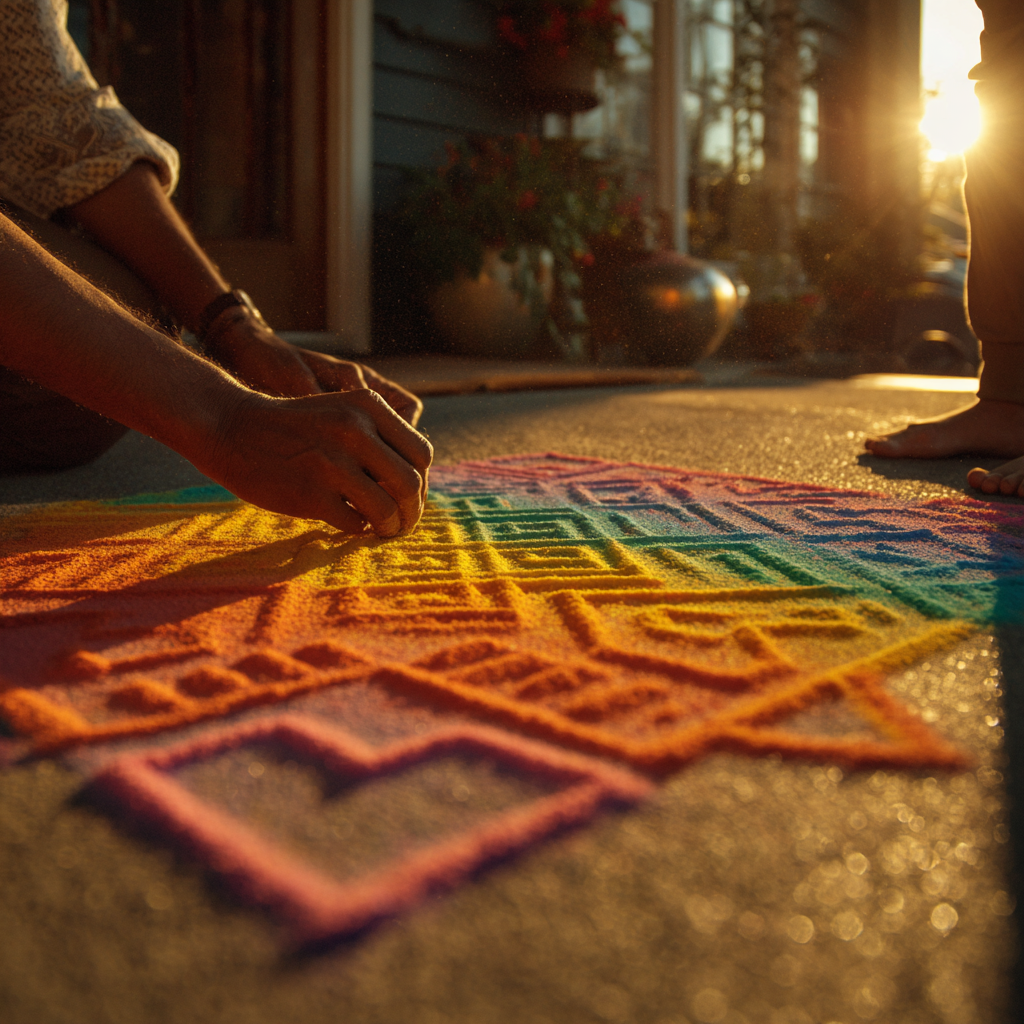
Two symbols. Two histories. One shape.
The Swastika, in its true sense, still means what it always has: well-being, good fortune, the wish that all may be well. Nothing the Nazis did can erase eleven thousand years of human use across dozens of cultures — but it did create a specific, purpose-built emblem of hate that deserves to be named accurately and rejected without hesitation. Getting that distinction right isn't a matter of Hindu, Jain, or Buddhist pride alone. It's a matter of precision that serves everyone, including — especially — the Jewish community, whose relationship to the hakenkreuz is rooted in real, generational grief that no historical footnote should minimize.
Well-being for all was always the point of the original symbol. That includes a Jewish family who should never again see that shape used as a weapon. And it includes a Hindu family free to draw it on their doorstep without fear. Reclaiming the Swastika was never about winning an argument. It was always about telling the truth — for both communities, at the same time.