
Dharmic Parenting • Family Ritual
A Back-to-School Puja: Starting the Year with Saraswati's Blessing
A simple family ritual to open the new school year with gratitude, focus, and the blessing of the Goddess of knowledge

Backpacks are packed, school supply lists are checked off, and across the country, Hindu American families are once again sending their children back into American classrooms. Amid the rush of new schedules and first-day photos, there's a quiet opportunity many families are reclaiming: pausing, even briefly, to bless the year of learning ahead. In Hindu Dharma, education has never been treated as a purely academic pursuit — it is a sacred undertaking, presided over by Goddess Saraswati, the embodiment of knowledge, wisdom, and the arts.
Who Is Goddess Saraswati?
Saraswati is one of the most revered deities in Hindu Dharma, worshipped since the Vedic period as the source of knowledge, speech, music, and creative expression. She is depicted seated on a lotus, dressed in white, holding a veena, a book, and a mala — symbols of harmony, learning, and disciplined practice. Unlike deities associated with wealth or power, Saraswati represents a different kind of abundance: clarity of mind, eloquence of speech, and the ability to learn deeply rather than merely memorize.
For students, artists, and anyone beginning a new pursuit of learning, invoking her blessing has long marked the start of that journey.
The Tradition of Vidyarambham
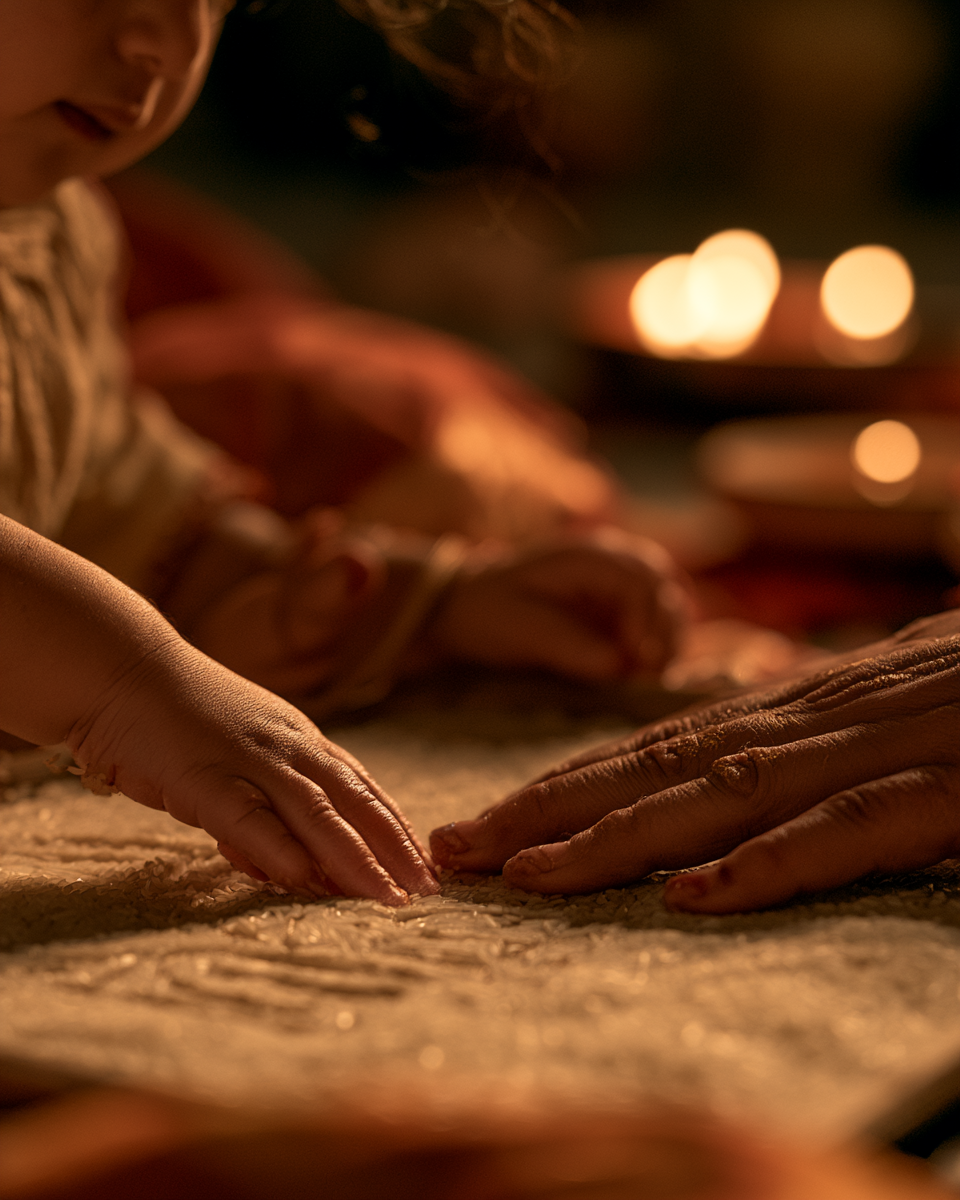
In India, this idea takes concrete form in a ritual called Vidyarambham — the beginning of study, or the start of a new educational pursuit or chapter. Traditionally observed around Vasant Panchami or during the Navratri and Dussehra season depending on region, Vidyarambham marks a child's formal initiation into learning: a parent or elder guides the child's hand to trace their first letters, often in a tray of rice or sand, before an image of Saraswati. Books, pens, and instruments are placed at her feet in gratitude for the year of learning past, and blessing for the year ahead.
The precise calendar date for Vidyarambham doesn't line up with the American school year, which typically begins in August or September. Rather than treating that as an obstacle, many Hindu American families have simply borrowed the spirit of the ritual and adapted its timing — using the start of the US school year as their own family's Vidyarambham moment, separate from (and in addition to) any traditional observance later in the year.
A Simple Back-to-School Puja for Home
This ritual doesn't require a priest, a temple, or elaborate preparation — just a few quiet minutes as a family before the first day of school.

1. Set up a small space. A corner of your home altar works fine — an image of Saraswati, a lit diya, and a few flowers.
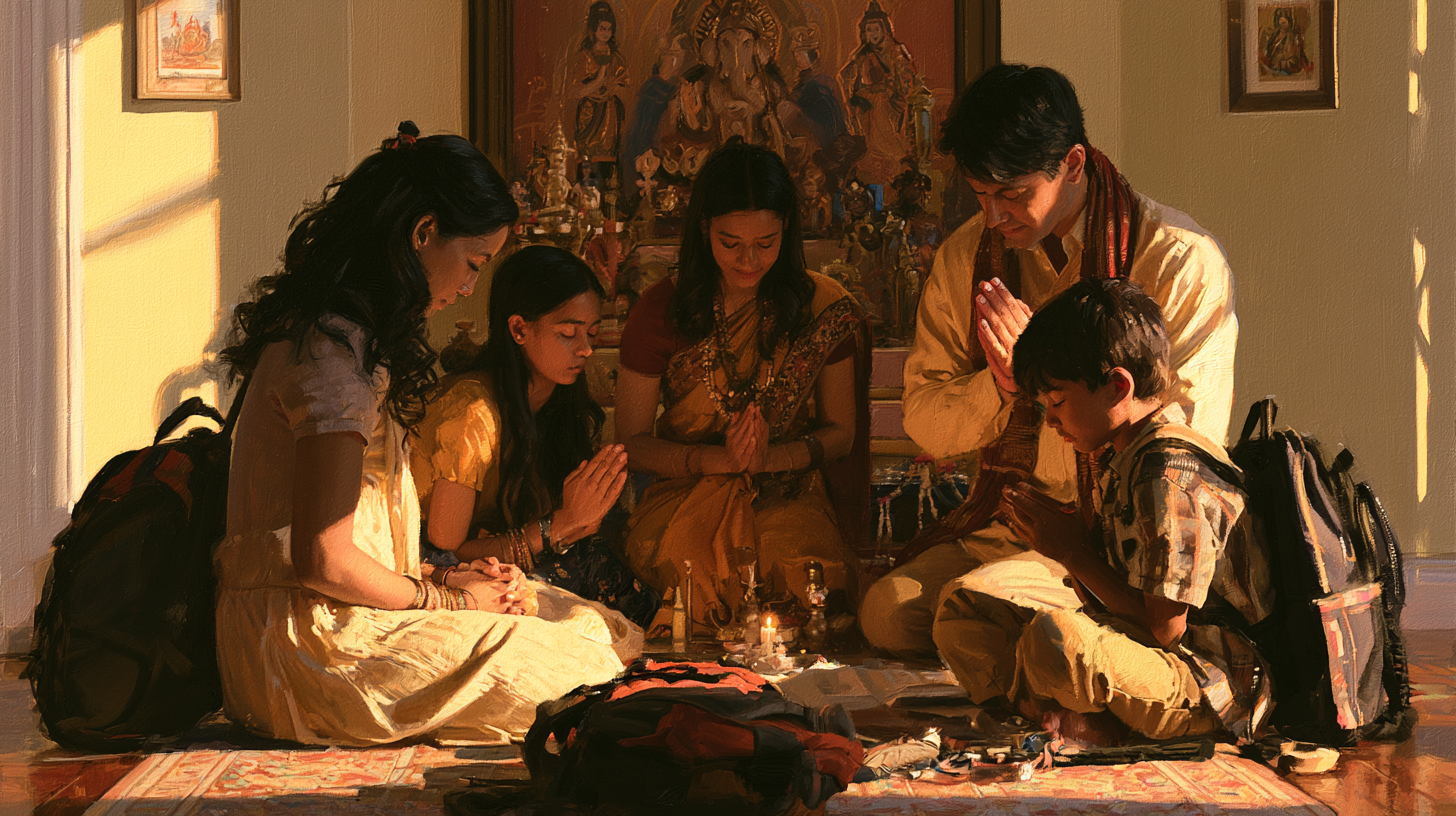
2. Place the school supplies before her. New backpacks, notebooks, pens, laptops, or textbooks can be arranged near the altar overnight or during the ritual itself — a modern echo of the traditional offering of books and instruments.
3. Light a diya and offer a short prayer. Even one minute of quiet intention — for focus, curiosity, and confidence in the year ahead — carries the essence of the ritual.
4. Chant the Saraswati mantra. A traditional shloka often recited by students before beginning a new lesson or a new year of study:
Saraswati namastubhyam varade kama-rupini
Vidyarambham karishyami siddhir bhavatu me sada
("Salutations to you, O Saraswati, granter of boons and fulfiller of wishes. I begin my learning — may it always be successful.")
Older children and teens can take part in their own way — reading the mantra aloud themselves, choosing which books to place before the altar, or simply sitting for a moment of quiet reflection on their goals for the year. Even a two-minute version of this ritual, folded into a busy first-day-of-school morning, gives children a small but meaningful marker: this year of learning begins with intention, not just an alarm clock.
Why This Small Ritual Matters
For Hindu American children navigating classrooms where their traditions are often unfamiliar to peers and teachers alike, small home rituals like this one carry outsized weight. They don't require explanation to anyone outside the family, they take almost no time, and they quietly reinforce something many American classrooms don't: that learning itself is worth treating as sacred, not just as a task to get through.
It's also a ritual that scales with the family. A five-year-old beginning kindergarten and a high schooler starting AP courses can both stand before the same altar, offer the same gratitude, and carry away the same reminder — that curiosity, humility, and effort are themselves forms of devotion.

Starting the Year Right
The American school calendar may not align with the Hindu lunar calendar, but the intention behind Vidyarambham travels easily across that gap. A blessed backpack, a lit diya, a mantra recited together as a family — these small acts turn the first day of school from a logistical scramble into a moment of shared gratitude and grounded confidence, for parents and children alike.

🕉️ Saraswati Namastubhyam