
◆ Seva & Community · Hurricane Helene
When the Mountains Flooded,
They Showed Up.
The cameras went to the celebrities and the politicians. But in the hollows of western North Carolina, Hindu Americans were quietly doing something the news never quite got around to covering: Seva.
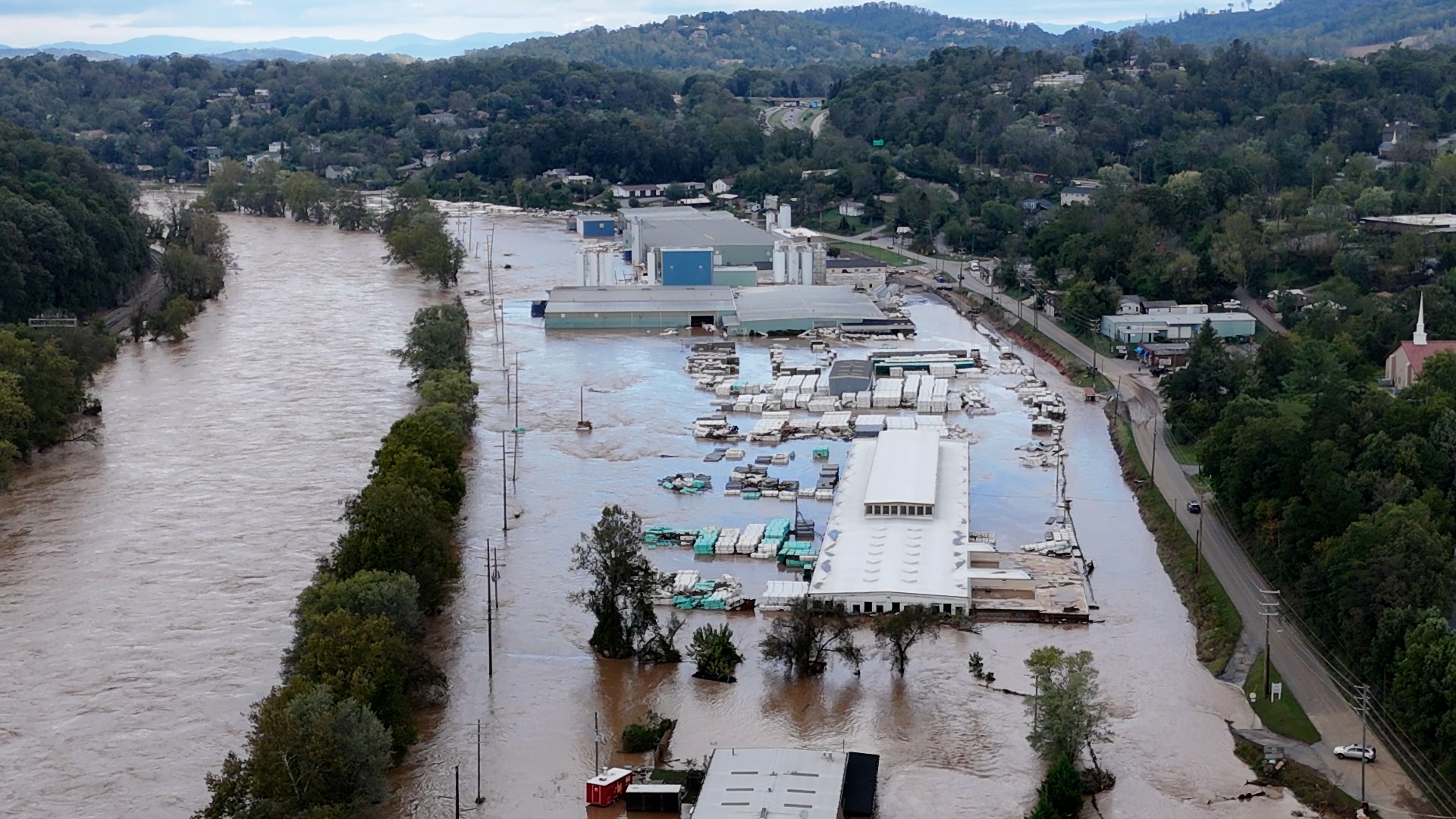
Floodwaters in western North Carolina following Hurricane Helene, September 2024.
On September 26, 2024, Hurricane Helene made landfall near Tallahassee as a Category 4 storm with 140-mile-per-hour winds. Then it kept going. It churned north through Georgia, the Carolinas, Tennessee, and Virginia — devastating communities that had no coastline, no hurricane plan, no reason to expect what hit them. Western North Carolina, tucked deep in the Blue Ridge Mountains, bore some of the worst damage in the storm's history. Roads vanished. Bridges collapsed. Towns were cut off for days. The death toll reached 252 people across multiple states, and the damage topped $78 billion, making Helene the costliest storm in North Carolina history.
The national news covered the politicians arguing and the helicopters overhead. It covered the FEMA delays and the social media fights. What it didn't cover — almost at all — was the quiet, unglamorous, deeply human work that happened in those mountains in the days and weeks after the storm. And part of that story belongs to the Hindu American community.
What Seva Actually Looks Like
In the Hindu tradition, Seva means selfless service. Not charity in the transactional sense — not giving to feel good, not donating to get credit. Seva is service as a spiritual practice. It is the understanding, rooted in the Gita, that to serve another person is to serve the divine within them. You do not serve because it is convenient. You serve because it is Dharma.
That is the lens through which Hindu Americans showed up after Helene. Not as a PR exercise. Not because anyone was watching. They showed up because it was the right thing to do — and they did it in communities that were not their own, for people who had no idea that the organization unloading supplies from the truck had roots in a tradition thousands of years old.
BAPS Charities: Hot Meals in the Mountains
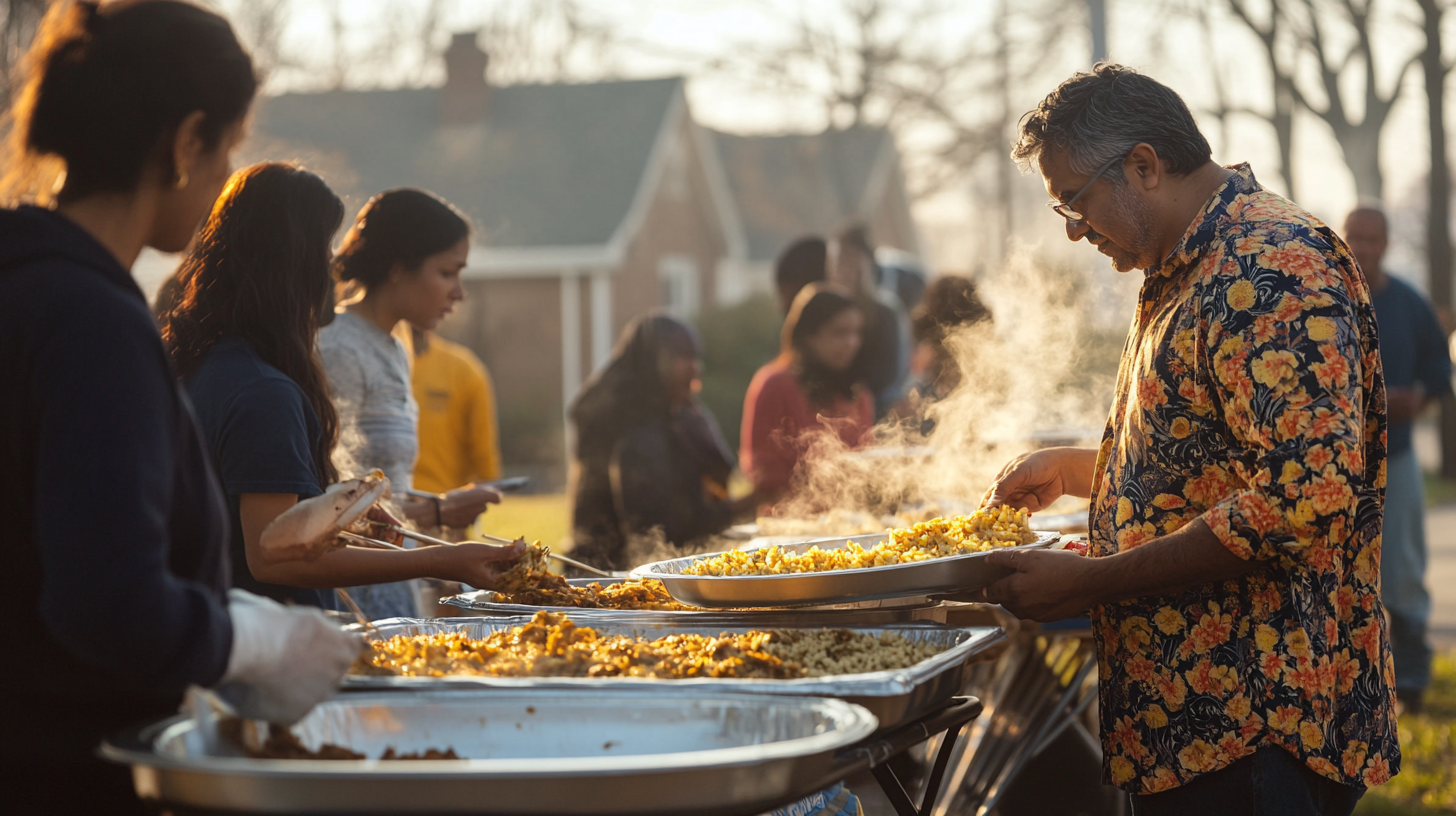
BAPS Charities volunteers prepared and distributed over 620 hot meal packs across four regions in the Carolinas.
Within days of Helene making landfall, volunteers from BAPS Shri Swaminarayan Mandir chapters in Greenville and Charlotte mobilized across four hard-hit regions. They weren't waiting for conditions to be perfect. They went in while roads were still uncertain and communities were still in shock.
Visit BAPS Charities →Between September 29 and October 3, those volunteers prepared and distributed 620 hot meal packs and 252 care packages across the affected regions. They contributed 358 volunteer hours — people cooking, loading trucks, navigating damaged roads, handing food directly to families who hadn't had a hot meal since the storm hit.
BAPS Charities coordinated directly with local authorities and emergency response teams to ensure supplies reached where they were most needed. This is not a small organization doing token outreach. This is a disciplined, logistically sophisticated charitable operation that activated quickly — and showed up when it mattered.
For those of us who know the BAPS community, this is not surprising. The same volunteers who build some of the most magnificent mandirs in the world also roll up their sleeves and pack care packages on folding tables in church parking lots during disasters. That is the culture. That is the tradition. And after Helene, it showed up in Asheville.
Sewa International: On the Ground, Clearing the Way
Sewa International — whose name literally means "selfless service" — deployed teams across the Southeast in the immediate aftermath of Helene. Their volunteers worked to clear roads, distribute food and water, and deliver aid to mountain towns and villages that larger organizations hadn't yet reached.
Visit Sewa International →Road clearing is not glamorous work. It doesn't photograph well. Nobody is going to put it in a fundraising video. But in western North Carolina, where entire mountain communities were cut off because debris and downed trees had made roads impassable, clearing a road meant that a family could get to a hospital. It meant a supply truck could get through. It was, in the most literal sense, lifesaving work.
Sewa International's presence was documented by multiple relief coordination organizations pointing families and donors toward trusted responders in the region. They were on the list of organizations doing real, on-the-ground work — alongside the Red Cross, Baptists on Mission, and Samaritan's Purse. A Hindu American organization, standing shoulder to shoulder with the faith-based responders that America is more accustomed to seeing in this role.
"A Hindu American organization, standing shoulder to shoulder with the faith-based responders that America is more accustomed to seeing in this role. Nobody put out a press release about it."
Nobody put out a press release about it. Nobody called CNN. The volunteers just went and did the work, and then went home, and went back to their regular lives. That is Seva. That is the point.
Why the News Missed It
Here is the honest truth about why this story didn't make the national news: it doesn't fit a familiar narrative. When faith-based disaster relief is covered in America, the story usually involves a church, a cross, and a recognizable denominational name. The template is well-worn. It is not that journalists are ill-intentioned — it is that they reach for the stories they already know how to tell.
Hindu Americans doing disaster relief in Appalachian mountain towns doesn't fit that template. There is no easy hook. The reporter doesn't know how to explain BAPS to a general audience in two sentences. The names of the volunteers are harder to pronounce. The tradition behind the work requires context that a 500-word web article doesn't have room for.
So the story doesn't get told. And the community that did the work — and does this work after every major disaster, quietly and without fanfare — remains invisible in the national imagination. That invisibility has a cost. It costs the Hindu American community the recognition it has earned. It costs the broader American public the knowledge that this community is a full participant in the life of the nation — not just in Silicon Valley or in medicine or academics, but in the muddy, unglamorous, essential work of showing up when neighbors are in crisis.
The Dharma of Showing Up
There is a passage in the Bhagavad Gita that Hindu Americans who do this work understand in their bones, even if they wouldn't necessarily quote it while handing out meal packs.
abhyutthānam adharmasya tadātmānaṃ sṛjāmy aham
The Dharmic call is not to wait for crisis to pass and then offer sympathy. It is to be present in the crisis — to embody, in whatever small and human way you can, the force that moves toward healing. That is what Seva means. That is what the volunteers who loaded trucks in Greenville and Charlotte and drove into flooded mountains were doing. They were answering a call that their tradition has been giving for thousands of years.
What You Can Do — And What We Should All Remember
Western North Carolina is still recovering. More than a year after Helene, communities in the mountains are still rebuilding. The headlines have long moved on, but the work continues — and organizations like BAPS Charities and Sewa International are still engaged in longer-term recovery efforts alongside their other ongoing seva work nationwide.
If you want to support Hindu American seva work in disaster relief, both BAPS Charities and Sewa International are reputable, efficient organizations with long track records. Donate to them. Volunteer with them. Tell people they exist.
And the next time someone asks you what Hindu Americans contribute to this country — beyond the doctors and the engineers and the entrepreneurs — you have an answer. You have the image of a volunteer in a BAPS sweatshirt handing a hot meal to a grandmother in Asheville who lost her basement to the flood. You have Sewa International volunteers clearing debris from a mountain road so that a supply truck could get through.
The cameras weren't there. But the people were. And that is what matters.
We don't do this for recognition. We do it because we were raised to understand that service to humanity is service to God. Helene was a call, and we answered it.
— The spirit of every Hindu American volunteer who showed upTo every Hindu American who packed a meal, cleared a road,
loaded a truck, or wrote a check when the mountains flooded —
your community sees you, even when the cameras don't.
That is the whole point of Seva.