
One Dharma, Many Shores
One flame, many hands — Hindu Americans from Gujarat, Trinidad, Fiji, and Nepal celebrate Diwali together.
Picture a Diwali celebration somewhere in America — a community center in New Jersey, a temple hall in Queens, a school gymnasium in Sacramento. Look around the room. A family from Gujarat lights their diya the way their grandmother did in Ahmedabad. Beside them, a family from Trinidad sings a verse of the Ramayan in Bhojpuri, the same words their great-great-grandparents carried across the Atlantic on an indenture ship. Across the room, an Indo-Fijian family arranges marigolds in a pattern their ancestors preserved through 150 years on a Pacific island. And near the door, a Nepali family arrives with sel roti, ready to celebrate Tihar in a land their grandparents never imagined reaching.
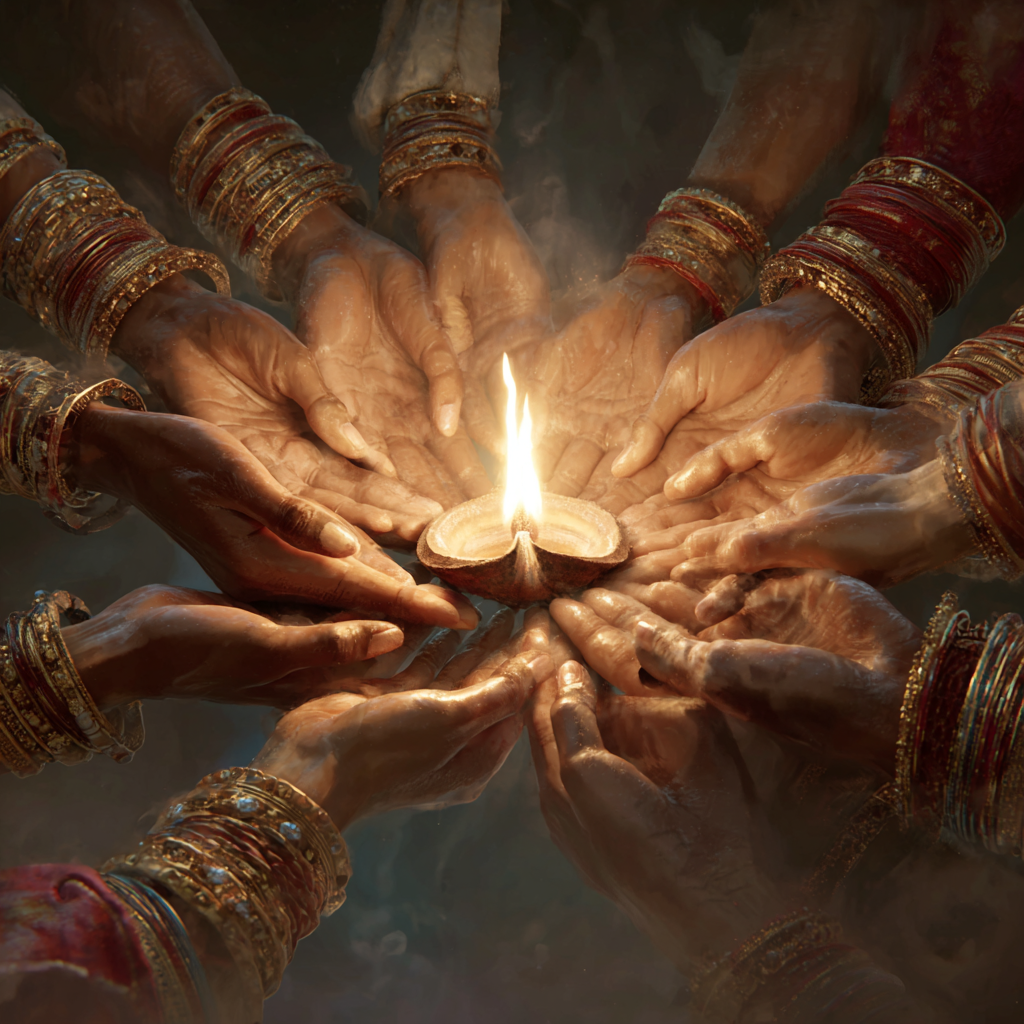
One flame. Many hands. One dharma.
This is Hindu America — and it is far more expansive, more resilient, and more varied than the shorthand of "Indian-American religion" can capture. Hinduism was born in Bharat — from the banks of the Sindhu and Saraswati, from the Vedic forests and the ancient cities of a civilization older than memory. But it did not stay contained there. Over centuries, it traveled — by ship, by indenture contract, by colonial decree, by faith — to the Caribbean, to the Pacific, to Southeast Asia, to the Indian Ocean islands. And then, carried by communities from all of those places, it arrived in America.
Today, when we say "Hindu American," we are speaking of one of the most geographically and culturally diverse religious communities in the United States. Understanding that diversity — honoring it — is essential to understanding who Hindu Americans truly are.
Gujarat, Tamil Nadu, Bengal, Maharashtra, Punjab — each region its own sampradaya, language, and sacred tradition.
Trinidad, Guyana, Suriname — dharma preserved across indenture, through the Ramayan sung from memory.
Fiji, Mauritius, Bali — girmityas and ancient Hindu kingdoms that kept dharma alive across oceans.
Nepal, Sri Lanka — Shaivite kingdoms and Agamic temple cultures carried across mountains and centuries.
Bharat: The Heartland, and Its Own Plurality
It is true that the largest share of Hindu Americans traces roots to the Indian subcontinent. And that alone is a story of extraordinary diversity. Gujarat, Tamil Nadu, West Bengal, Maharashtra, Punjab, Odisha, Andhra Pradesh — each region carries its own spiritual lineage, its own festivals, its own sampradayas and languages and ways of approaching the Divine. A Shaiva Tamil family and a Vaishnava Gujarati family may both call themselves Hindu Americans, yet their temple traditions, ritual calendars, and sacred languages may share little on the surface, even as they draw from the same inexhaustible source.
One of the most visible expressions of Indian subcontinent Hindu American institutional life. Founded in 1907 and rooted in the Bhakti tradition of Bhagwan Swaminarayan, BAPS Swaminarayan Sanstha today operates hundreds of centers across North America. Its mandir in Robbinsville, New Jersey — the largest Hindu temple outside India — is not merely a place of worship. It is a landmark of what Hindu Americans have built in this country: with their hands, their donations, their devotion, and their decades of commitment to community.
Advocacy organizations like the Hindu American Foundation (HAF) and the Coalition of Hindus of North America (CoHNA) have extended this presence into the civic sphere — working on K-12 textbook accuracy, civil rights, and legislative advocacy on behalf of Hindu Americans of every national origin and background.
The Caribbean Hindus: Dharma Preserved Across Oceans
Between 1838 and 1920, the British colonial system shipped hundreds of thousands of laborers from the Indian subcontinent — most from the regions of present-day Uttar Pradesh and Bihar — to sugar plantations in Trinidad, Guyana, Suriname, and beyond. They came under indenture contracts, a system so brutal in its erasure of identity that colonial authorities banned Indian languages in schools and pressured laborers to take English names.
And yet — Hinduism survived.
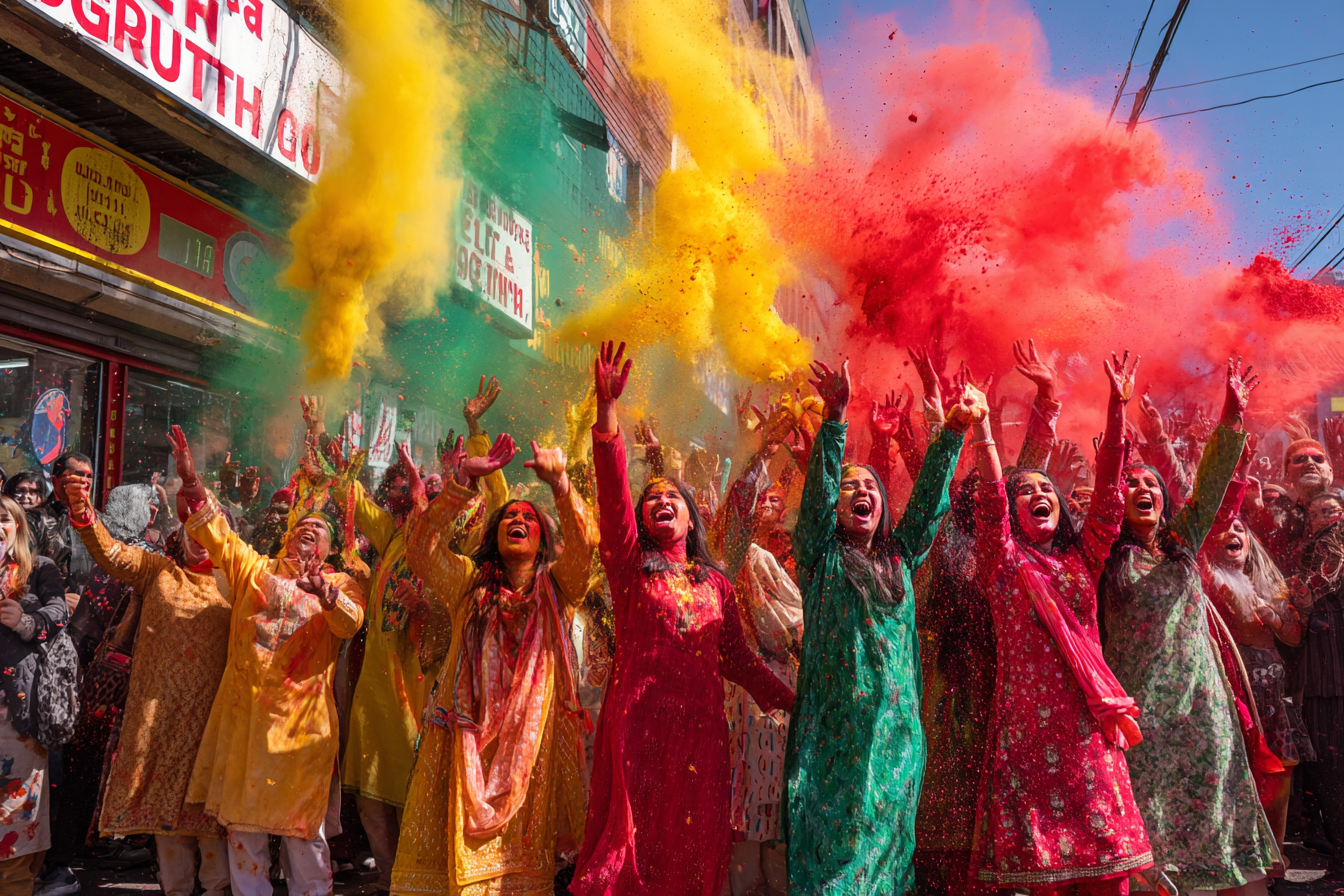
It survived through the Ramayan, recited from memory when no printed copies were available. It survived through Ramleela performances that became community anchors. It survived through Phagwah — the Caribbean expression of Holi — celebrated each spring with a joy that carries within it the weight of everything that could not be taken away. It survived because the families who carried it refused to let it die.
By 1952, Trinidad's Hindu community had organized the Sanatan Dharma Maha Sabha, unifying major Hindu groups into a single institution that built schools, standardized temple practice, and gave the community an institutional voice. It was, in many ways, a blueprint for what organized dharmic community life could look like under pressure — a lesson that resonates for Hindu Americans navigating their own moment.
"The life I live today is the direct result of generations who sacrificed stability, identity, and even language, to hold on to their Hindu faith."
— Shawn Binda, educator and host of Hindu Lifestyle on YouTubeIn New York, that presence is unmistakable. The Richmond Hill Phagwah Parade in Queens is the largest Holi celebration in the United States — thousands of people filling Liberty Avenue each spring in an explosion of color and devotion. Streets in Queens have been co-named to honor Guyanese Hindu community leaders like Pandit Ramlall and Ritwantee Persaud. The Indo-Caribbean Hindu community is not a footnote in the story of Hindu America. It is one of its oldest and most resilient chapters.
Fiji, Mauritius, and the Pacific Rim
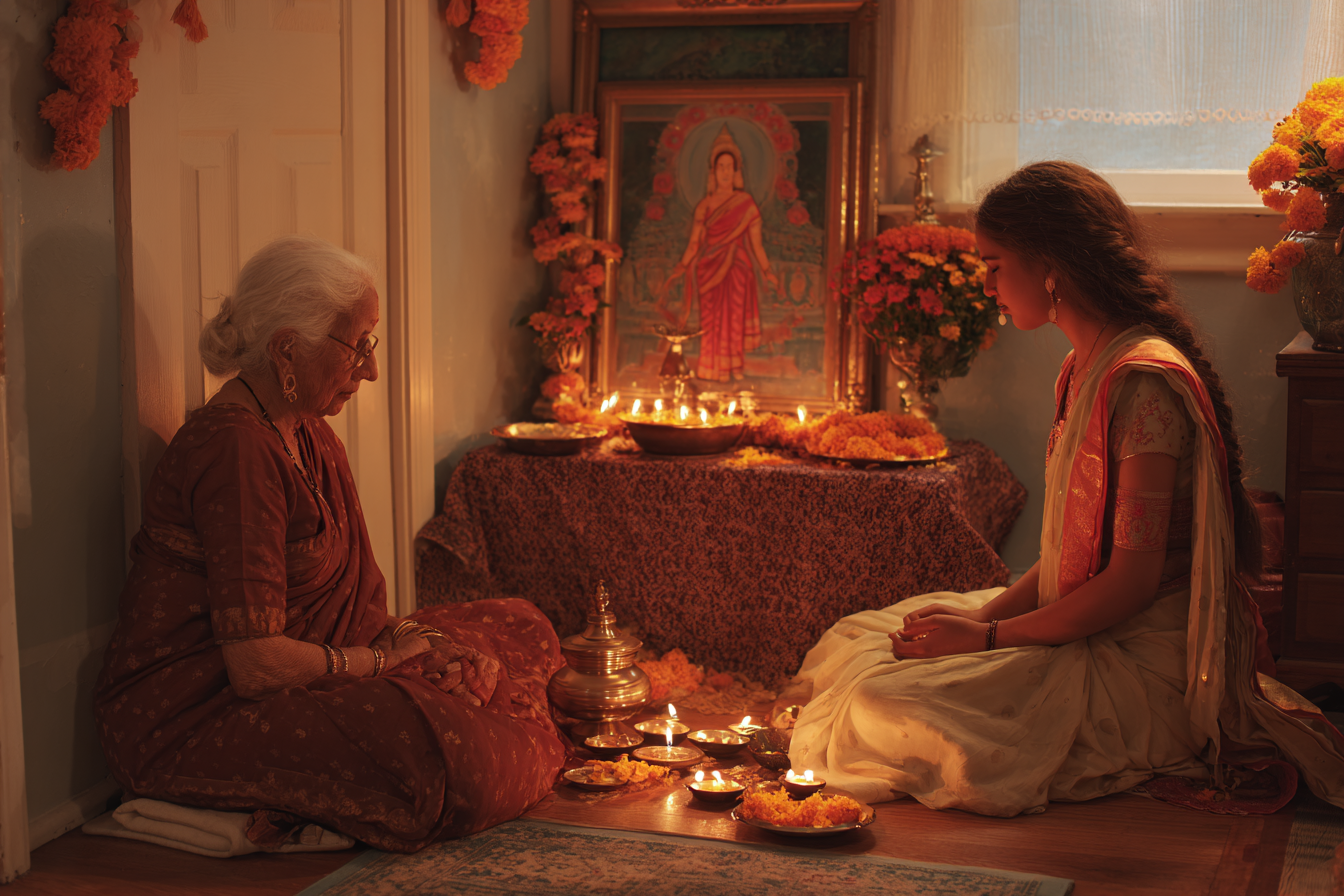
The same indenture system that shaped the Caribbean also reached across to the Pacific. From 1879 onward, Indians — predominantly Hindu — were brought to Fiji under labor contracts to work the sugarcane fields. The colonial authorities called them girmityas, a corruption of the word "agreement." It became, over time, a badge of identity — and of honor.
And then there is Bali — where Hinduism arrived over a thousand years ago and evolved into a tradition entirely its own. Balinese Hinduism, with its distinctive temple architecture (pura), its integration of music, dance, and devotion into daily life, and its own theological frameworks, represents one of the most vivid examples of dharma's capacity to take root, flower, and become something new without ceasing to be itself. Balinese Hindu Americans carry this living tradition into the American story.
What unites these communities — Caribbean, Fijian, Mauritian, Balinese — is what might be called the girmitya spirit: the stubborn, creative, faithful insistence on preserving what matters most, even when everything around you is trying to erase it. That spirit is as dharmic as any text.
Nepal, Sri Lanka, and the Himalayan World
Hinduism's global reach is not only a story of the colonial indenture system. It is also the story of Himalayan kingdoms and ancient civilizations that carried dharma on their own terms.
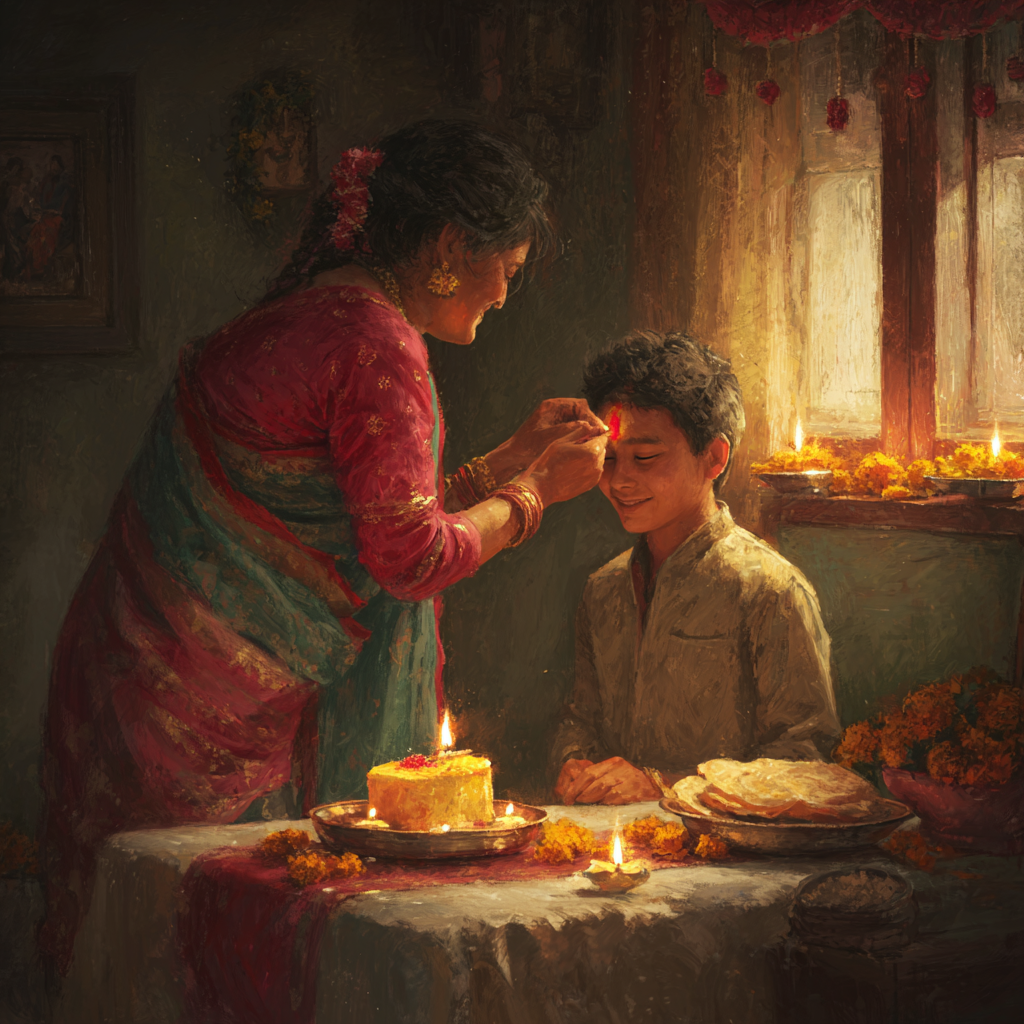
Nepali Hindu Americans represent one of the fastest-growing communities in the country — 219,503 Americans identified as Nepali in the 2020 census, a 269% increase from a decade earlier. Nepal, the only nation in history to have held Hinduism as its state religion, carries a distinctly Shaivite and Shakta spiritual character. Dashain and Tihar — Nepal's great autumn festivals — are now celebrated in diaspora homes from Virginia to Texas to California.
Sri Lankan Tamil Hindus bring another strand entirely: the Shaiva Siddhanta tradition, one of Hinduism's most philosophically sophisticated schools, expressed through a deep Agamic temple culture. Kovils — Tamil Hindu temples with their distinctive gopuram towers — now stand in cities across America, serving communities shaped by both millennia of devotion and, for many, the trauma of displacement. Their presence in America is a testimony to dharma's capacity to survive and renew itself under the most difficult conditions.
Taken together, the Nepali, Sri Lankan, and broader Himalayan Hindu American communities are a reminder that Hinduism's geography was never defined by any single political border. It moved with the people who carried it — across mountains, across oceans, across centuries.
One Community, Many Contributions
Across all of these streams — Indian subcontinent, Caribbean, Pacific, Himalayan — Hindu Americans have contributed to this country with the full range of their gifts.
Born in American Samoa and raised in Hawaii as a practitioner of Gaudiya Vaishnava Hinduism, Gabbard made history in 2013 as the first Hindu elected to the United States Congress. She is herself a living example of the article's central point: Hindu identity is not synonymous with Indian subcontinent heritage.
In technology, Hindu Americans of Indian subcontinent origin have risen to lead some of the most consequential companies in the world — Google, Microsoft, Adobe, IBM — bringing to those roles a tradition that has always understood knowledge, jnana, as sacred. In medicine, in academia, in the arts, in community service, the pattern holds: a community that takes seriously the dharmic call to contribute.
Institutionally, BAPS Public Affairs' annual Advocacy Day now reaches 187 Congressional offices. HAF works year after year to ensure that Hinduism is accurately represented in American classrooms. CoHNA mobilizes grassroots Hindu Americans — from every background and national origin — to engage their elected representatives. These are not the actions of a community that has retreated into its temples. They are the actions of a community that understands its place in American civic life and is willing to show up for it.
Bringing It Home
The next time someone asks what a Hindu American looks like, the honest answer is: look carefully, because you will find them everywhere — and they will not all look the way you expect.
Priya's grandmother in a New Jersey suburb, keeping a small brass Ganesha on the kitchen counter and reciting the Hanuman Chalisa before sunrise — her Tamil tradition carried intact from Chennai to Cary to this quiet American morning.
The Richmond Hill uncle in Queens who still knows every verse of the Ramayan by heart, whose grandfather learned it not from a printed copy but from an elder who learned it on a sugarcane plantation in Trinidad, where books were scarce and memory was everything.
The Indo-Fijian family in Sacramento whose children go to public school on Monday and sit for puja at the temple on Sunday, holding simultaneously the Pacific island their parents left, the subcontinent their great-grandparents departed, and the American city they are now making their own.
The Nepali student in a Virginia dormitory decorating her room with a Dashain tika, calling her family in Kathmandu on video, bridging two worlds with a single red mark on her forehead.
Shawn Binda in Toronto, teaching a class of teenagers the history their schools never told them — how their ancestors crossed oceans under indenture and kept the Ramayan alive, how their identity as Hindus was not given to them but fought for, generation by generation. And exploring Hindusim on his YouTube channel HinduLifestyle .
Tulsi Gabbard placing her hand on the Bhagavad Gita to take her oath of office — not because she is from India, but because dharma found her, as it has found people across every shore it has touched.
These are not separate stories. They are the same story — told in different languages, across different oceans, from different starting points, arriving at the same truth. Hinduism was born in Bharat, sacred and ancient and inexhaustible. And because it was that deep, it could travel that far.
One dharma. Many shores. One community, still becoming.
Satyameva Jayate. Truth alone triumphs.
🙏