
Bollywood Is Not the Veda:
Why Hindu Americans Must Stop
Outsourcing Their Identity to Cinema
For decades, we have let a commercial film industry shape how our children — and the world — understand Hinduism. It is time to talk honestly about what that has cost us.
A parent presses play on a Bollywood film for their teenage daughter. "This will help you connect with your culture," they say. The film opens with a priest portrayed as a scheming fraud. A temple backdrop built out of cardboard and paint. A hero who "rescues" the heroine by mocking her family's puja. And a love song built entirely of Urdu-Persian words that have no root in Sanskrit or the Vedic tradition at all.
The daughter watches. She learns. Just not what her parents hoped.
The Myth of Bollywood as "Hindu Cinema"
The first thing every Hindu American family deserves to understand is this: Bollywood was never built as a Hindu cultural institution. It was designed as a secular, pluralist entertainment enterprise optimized for the widest possible commercial audience. Many of its most iconic lyricists, composers, directors, and writers came from backgrounds deeply shaped by Urdu literary traditions, Marxist politics, or secular nationalism — not Hindu philosophy.
This is not a complaint about those individuals. They made extraordinary art. But it is the essential context that changes everything about how we should receive Bollywood as a community.
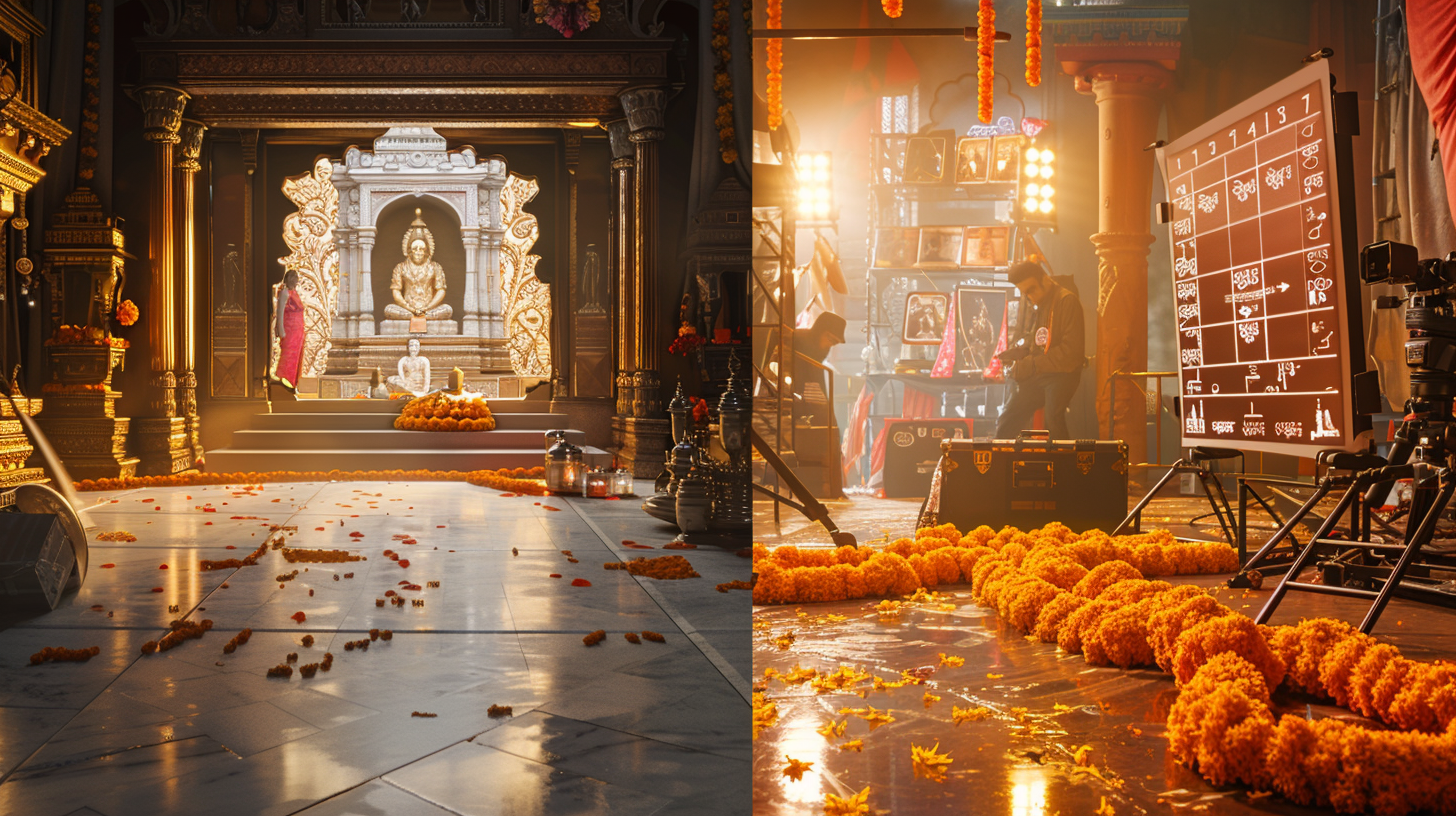
The problem arises when diaspora families mistake cultural aesthetics — saris, diyas, temple backdrops, Sanskrit shlokas playing softly in the background — for authentic representation. Surface-level imagery is not the same as cultural fidelity. A cardboard mandir is not a mandir.
The Language of Bollywood Is Not the Language of the Vedas
Here is something most people — including many Hindus — do not realize: the language spoken in Bollywood films is not really Hindi as rooted in Sanskrit. It is Hindustani — a hybrid register heavily infused with Urdu, which itself draws its higher vocabulary from Persian and Arabic, not from the Vedic tradition.
This is not accidental. Historically, many of Bollywood's most celebrated lyricists and songwriters wrote in Urdu. Their vocabulary, their idiom, their poetic sensibility came from the Persianate literary world — from the Mughal court's cultural inheritance, not from the river of Sanskrit civilization that gave Hinduism its voice. Researchers who have studied decades of Bollywood film titles found that Urdu remains "profusely utilized" in mainstream Hindi cinema, prominently featured in blockbusters across every generation.
(Urdu–Persian roots)
Ishq Mohabbat Junoon Arzoo Dil ZindagiThese words play at Hindu weddings and Diwali parties — yet none trace to Sanskrit or the Vedic tradition.
(Sanskrit roots)
Prema Bhakti Dharma Karma Atman MokshaThe living vocabulary of the Vedas, the Upanishads, and the Bhagavad Gita — rarely heard in mainstream Bollywood.
A child raised on Bollywood songs is not being raised on the language or the literary tradition of Hinduism. They are being raised on a beautiful, blended, commercial culture that happens to use Indian faces and settings — while drawing its deepest aesthetic waters from a very different well. The Persianate culture of the Mughal court is a rich heritage, but it is not the heritage of the Vedas, the Upanishads, or the Bhagavad Gita.
How Bollywood Misrepresents Hinduism
The linguistic distortion runs parallel to deeper distortions in how Hinduism itself is portrayed on screen. These are not random occurrences. They follow clear, recurring patterns documented extensively by cultural critics and researchers:
A film industry that has spent decades making the tilak a symbol of the villain cannot also be your community's trusted teacher of Hindu values.
DharmikAmerica — Community Education SeriesWhat This Does to the Next Generation
For a 12-year-old Hindu American who consumes Bollywood content, these messages compound over time. They are not absorbed as fiction. They are absorbed as cultural truth — because nothing else is offering a counter-narrative at the same volume and regularity.
They slowly internalize that being religiously observant makes you a villain or a joke. That Hindu rituals are superstitions that "educated" people have moved past. That the "cool," desirable version of Indian identity is secular and Westernized. That temples are for grandparents — not for them.
This is not hypothetical. It is the predictable result of decades of media conditioning. And non-Hindu Americans who watch Bollywood walk away with a similarly warped picture — one where Hinduism appears as a collection of superstitions and rigid customs that progressive Indians are heroically transcending.
Anti-Hindu bias in academic institutions, distorted portrayals in Western media, and peer pressure to conform to secular frameworks already create headwinds for Hindu American youth. When the community's own chosen entertainment reinforces those narratives from within, the damage compounds. The wound comes from inside the house.
What Should Hindu American Families Do Instead?
This is not a call to banish Bollywood from your home or strip the fun from movie nights. If you can cut off Bollywood from your life and replace it with a meaningful way of joy & entertainment, kudos to you! But if you can't for a reason, enjoy it as entertainment - with open eyes. And treat it the way you would treat any entertainment: with critical awareness, not cultural reverence.
A Closing Thought
Bollywood is a commercial entertainment industry. Like Hollywood, it follows money, trends, and the cultural preferences of its most powerful gatekeepers. For most of its history, those gatekeepers were shaped by secular nationalism, Urdu-Persianate literary aesthetics, and a deliberate distancing from Hindu religious identity.
The result is a body of cinema that is dazzling, melodious, and emotionally compelling — but was never designed to be a faithful representation of Hindu dharma. Commercial cinema and sacred tradition answer to different masters. Confusing the two is a mistake our community can no longer afford to make.
Your children deserve to know the real thing. And the real thing — the Gita's vision of duty and liberation, the Ramayana's meditation on virtue and devotion, the Upanishads' inquiry into the nature of consciousness — is far more beautiful, far more intellectually rich, and far more worthy of their pride than anything that has ever come out of Film City, Mumbai.
The tradition that shaped one of the world's oldest civilizations is alive. Its people are here, practicing, and paying attention. Give your children the real inheritance — not a cinematic imitation of it.
DharmikAmerica · Rooted in Dharma · Rising in America