
From hurricane relief to food pantries to disaster response, Hindu Americans are serving communities across the United States through the ancient principle of seva. Here’s the full story.
By the DharmikAmerica Team | May 2026
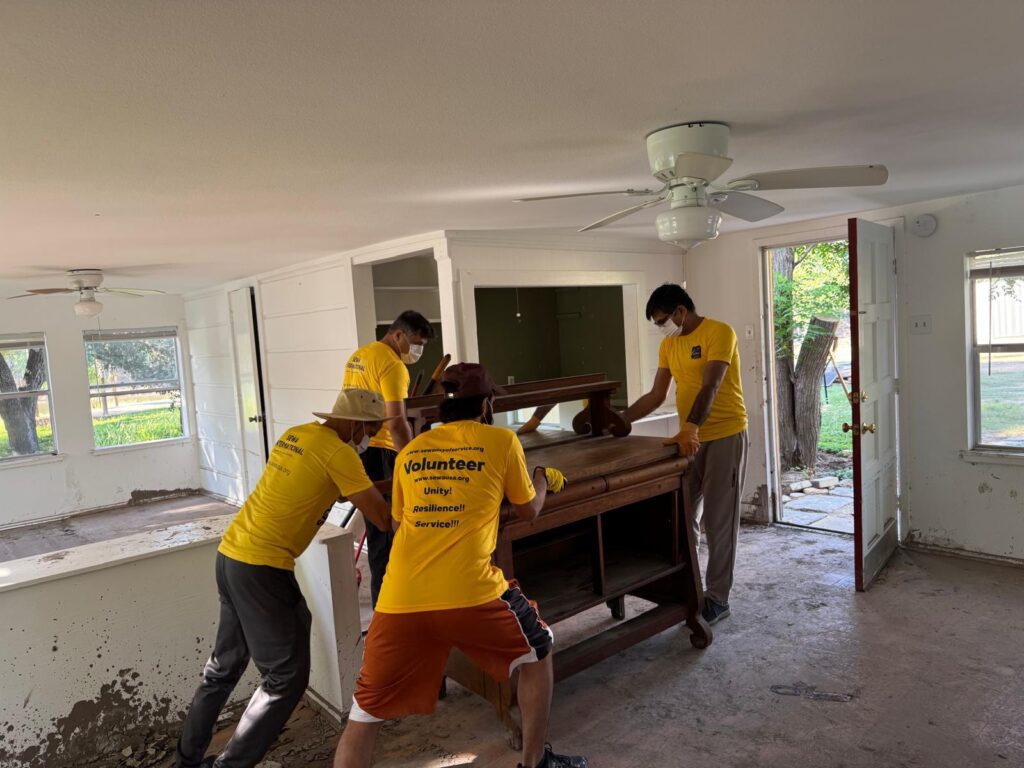
When floodwaters swept through Kerrville, Texas on July 4, 2025, claiming over 110 lives and leaving hundreds of families without homes, the first outside responders to arrive weren’t from a large national relief agency.
They were Hindu Americans.
Volunteers from Sewa International — a Hindu faith-based nonprofit — drove in from Houston and San Antonio within hours of the disaster. They worked alongside local emergency teams, coordinated cleanup, delivered supplies, and stayed for months of long-term recovery. When the City of Kerrville officially honored them in December 2025, Mayor Joe Herrington said something that captured the moment perfectly:
“This wasn’t just emergency response — it was a ministry.”
That word — ministry — applied to a Hindu organization, by a Texas mayor, at a public ceremony. It says everything about how Hindu Americans are reshaping what service looks like in this country.
What Is Seva — and Why Does It Matter?
Before we tell the story of Hindu Americans serving the nation, it helps to understand why they do it.
Seva (pronounced say-vaa) is a Sanskrit word that translates as selfless service. But in the Dharmik (Sanatan Dharma) worldview, it is far more than volunteerism. It is a spiritual practice — a recognition that serving another human being is, in the deepest sense, serving the divine.
The Vishwa Hindu Parishad of America (VHPA) puts it this way: “Nar-seva is Narayan-seva” — serving a person in need is as precious as serving God.
This is not a metaphor. For observant Hindus, the act of feeding a hungry neighbor, cleaning up after a flood, or sitting with a grieving family is woven into the same fabric as prayer, puja, and pilgrimage. Seva is not something you do after your spiritual life. It is spiritual life.
This understanding is why Hindu American organizations don’t serve only their own community. They serve whoever is in front of them — regardless of faith, race, or background. It is, quite literally, the point.
The Organizations Carrying Seva Forward in USA
Sewa International — From Harvey to Texas Hill Country
Founded in 1989 and headquartered in Houston, Sewa International is perhaps the most visible face of Hindu American disaster relief in the United States. With 43 chapters across the country, the organization has responded to more than 50 disasters over 35 years — including Hurricane Katrina, Hurricane Harvey, and the 2025 Texas Hill Country floods.
After the July 4, 2025 Kerrville floods, Sewa mobilized a multi-city volunteer force, launched a $250,000 emergency relief fund, and coordinated with the Texas Department of Emergency Management, the Salvation Army, and local VOAD networks. Over 200 Sewa volunteers contributed more than 3,000 service hours in the weeks that followed. The Indo-American Charity Foundation contributed $60,000 directly to Kerrville’s recovery.
City leaders credited Sewa for being among the first organizations to arrive — and among the last to leave.
In 2025, building on lessons from Kerrville, Sewa launched its first dedicated Disaster Response Vehicle — a mobile command center that can be pre-staged and deployed within the critical first 72 hours of any disaster. It is the kind of institutional investment that speaks to long-term commitment, not one-time charity.
Sewa’s guiding principle is simple: they serve regardless of race, color, religion, sex, age, disability, or national origin.

BAPS Charities — Millions of Volunteer Hours, Nationwide
BAPS Charities, the service arm of the BAPS Swaminarayan Sanstha, operates across nine countries and five continents — with some of its most active chapters right here in the United States.
In Southern California alone, recent seva activities have included distributing 4,000 pounds of food alongside Congresswoman Norma Torres for Thanksgiving 2025, donating over 500 pounds of food to Shepherd’s Pantry during the 2026 government shutdown, and providing 750 hot meals, blankets, winter gloves, and medical supplies to unhoused neighbors in partnership with SevaSphere.
BAPS Charities works in five key areas: Community Empowerment, Educational Services, Environmental Protection, Health & Wellness, and Humanitarian Relief. Their volunteers — motivated by the spirit of seva rather than incentives — collectively donate millions of hours annually to American communities.
The Spiritual Roots: Pramukh Swami Maharaj & Mahant Swami Maharaj
To understand why BAPS volunteers serve with such consistency and depth, you have to understand the two spiritual leaders who shaped the organization’s soul.
Pramukh Swami Maharaj (1921–2016), the fifth spiritual successor of Bhagwan Swaminarayan and longtime head of BAPS, lived by a single guiding maxim that became the heartbeat of the entire movement: “In the joy of others lies our own.” This was not a slogan — it was a biography. He personally cleaned temples, cooked for devotees, washed dishes, and nursed the sick, even as he led a global spiritual organization of millions. As President Barack Obama wrote upon his passing, Pramukh Swami Maharaj “spent his life using the power of his inner goodness to lift others up… By paying tribute to a man who believed in the worth of all people and dedicated himself to serving those in need, we are reminded of the ways our common humanity will always bind us together.”
His Holiness Mahant Swami Maharaj, the sixth and current spiritual guru of BAPS, carries this torch forward. Known for a life of complete humility and selfless action, Mahant Swami Maharaj has taught that seva must flow from within — free of ego and pride. His teaching is direct: “One should abandon ego and possessiveness and then perform seva-bhakti. Then we will truly have made it.” His own life embodies this — from joining manual labor under the hot sun alongside volunteers, to performing the humblest tasks at mandirs throughout his decades of service. At a Seva Day celebration honoring Pramukh Swami’s legacy, Mahant Swami Maharaj said simply: “Pramukh Swami Maharaj’s entire life was dedicated to the service of others.” It is a flame he keeps burning.
This lineage — from Bhagwan Swaminarayan’s founding spirit of seva, through Pramukh Swami’s golden maxim, to Mahant Swami’s living example — is what drives BAPS volunteers in American food pantries, blood drives, disaster zones, and community centers today. As BAPS Charities’ own mission states, seva means “not just volunteering time or donating money, but being motivated by a spirit of service to sacrifice for the greater good.”
Hindu American Seva Communities — Building National Infrastructure
Hindu American Seva Communities (HASC), founded by Anju Bhargava in 2009, took a different but equally important approach. Rather than focusing only on direct service, HASC set out to build the infrastructure of Hindu American seva — the platforms, training, and partnerships that would allow the community’s service tradition to scale.
As Religion News Service reported, working under the guidance of the White House Office of Faith-Based and Neighborhood Partnerships, HASC established itself as a formal service partner with the Corporation for National and Community Service. It partnered with college campuses, supported Hindu Americans in the armed services, and created toolkits for temples to launch their own community service initiatives.
The vision: let a thousand flowers bloom. And they have.
VHPA — Serving Through Temples Across America
The Vishwa Hindu Parishad of America (VHPA) coordinates seva through a network of chapters and Hindu temples across the country. From soup kitchens and shelters to disaster relief and resources for abused women, VHPA’s seva work is embedded in the daily life of Hindu communities from coast to coast. Their chapters engage in activities that range from cultural education to direct community service, often in partnership with local organizations.
The Hindu American Foundation — Advocacy as Seva
The Hindu American Foundation (HAF), founded in 2003, approaches seva through a different lens: advocacy. By working on K-12 textbook accuracy, civil rights, environmental protection, and interfaith dialogue, HAF serves the broader American public by ensuring that Hindu perspectives are accurately represented and that Hindu Americans can participate fully in civic life. During Diwali, HAF highlights the tradition of dana (charitable giving) as inseparable from the festival’s meaning.
When America Needed Help, Hindu Americans Showed Up
The story of Hindu American seva is not only told in quiet, everyday acts. It is also told in moments of national crisis — when disaster struck and Hindu Americans drove through the night to help strangers.
Hurricane Harvey (2017): When Harvey devastated Houston — home to one of the largest Hindu American communities in the country — Sewa International was already there. With 41 chapters and a Houston headquarters, they led a coordinated relief effort joined by 25 national and local Indian American organizations. Over 800 volunteers mobilized for rescue and relief, raising $250,000 in just ten days. Community members who had just lost their own homes turned immediately to asking how they could help others.
Texas Hill Country Floods (2025): As described above, Sewa’s response to the July 4 floods was widely praised by Texas officials. The Hill Country Community Journal reported that Sewa presented $60,000 in checks to Kerrville and pledged to maintain its presence for long-term rehabilitation — part of a track record of responding to more than 50 disasters over 35 years. The City of Kerrville formally honored Sewa and its partner organizations — a recognition that would have been nearly unimaginable a generation ago.
California Wildfires: Sewa has also responded to California wildfire disasters, part of a pattern of showing up for communities across every region of the country.
In each of these moments, Hindu Americans did not wait to be invited. They showed up — motivated not by recognition, but by a 5,000-year-old teaching that the highest form of worship is service.
A Community That Lives Here and Gives Here
Perhaps the most striking thing about Hindu American seva is not its scale — though the scale is remarkable. It is the philosophy behind it.
Pankaj Rana, president of the Indo-American Charity Foundation of Houston, said it clearly after the Kerrville floods: “We live here, we give here. We don’t send our money to any part of the globe.”
That statement reflects something important about the Hindu American community’s relationship to this country. These are not hyphenated Americans with one foot elsewhere. They are Americans — rooted, committed, and deeply invested in the wellbeing of their neighbors, their cities, and their nation.
And their faith drives it. Not as a transaction — not for conversion, not for recognition — but because Sanatana Dharma teaches that you cannot separate your spiritual life from your civic life. Dharma is not just personal righteousness. It is right action in the world.
What Seva Looks Like — By the Numbers
- 43 chapters of Sewa International across the United States
- 50+ disaster responses by Sewa over 35 years, including Katrina, Harvey, and the 2025 Texas floods
- 3,000+ volunteer hours contributed by Sewa volunteers in the Kerrville response alone
- $60,000 donated directly by Hindu American organizations to Kerrville flood recovery
- 4,000 pounds of food distributed by BAPS Charities in a single Thanksgiving event in Los Angeles
- Millions of volunteer hours donated annually by BAPS Charities volunteers across the United States
- 9 countries where BAPS Charities operates, with some of its most active chapters in the US
The Bigger Picture
Hindu Americans make up roughly 1% of the US population. By virtually any measure — education, income, civic participation, and now organized community service — they punch far above their weight.
But seva is not about punching above your weight. It is not about visibility, credit, or comparison. It is about showing up. About seeing a need and responding to it as a spiritual calling.
As America grows more diverse, more complex, and more in need of communities that can hold together across difference, the Hindu American tradition of seva — rooted in the conviction that every person is divine — offers something this country genuinely needs.
The quiet work continues. In food pantries and flood zones. In temple halls and hospital waiting rooms. In cities and suburbs across America.
Hindu Americans are here. And they are here to serve.
How You Can Get Involved
If you are a Hindu American looking to bring seva into your own life, here are organizations to explore:
- Sewa International | Disaster relief, education, development
- BAPS Charities | Community empowerment, health, humanitarian relief
- VHPA Seva | Local community seva through temples
- Hindu American Foundation | Advocacy and civic participation
Seva begins where you are. Your temple, your neighborhood, your city. Start there.
Know a Hindu American seva story that deserves to be told? Write to us at DharmikAmerica@gmail.com. This community’s service is too important to go unnoticed.
DharmikAmerica.com — Dharmik Life. American Soul.