
Dharmic Life · DharmikAmerica.com
Dharmic ParentingRaising Hindu Kids in America:
How to Keep Dharma Alive
in the Western World
Raising Hindu children in America comes with unique challenges and beautiful opportunities. Practical, heartfelt ways to pass on Dharmic values, culture, and identity — without the conflict.
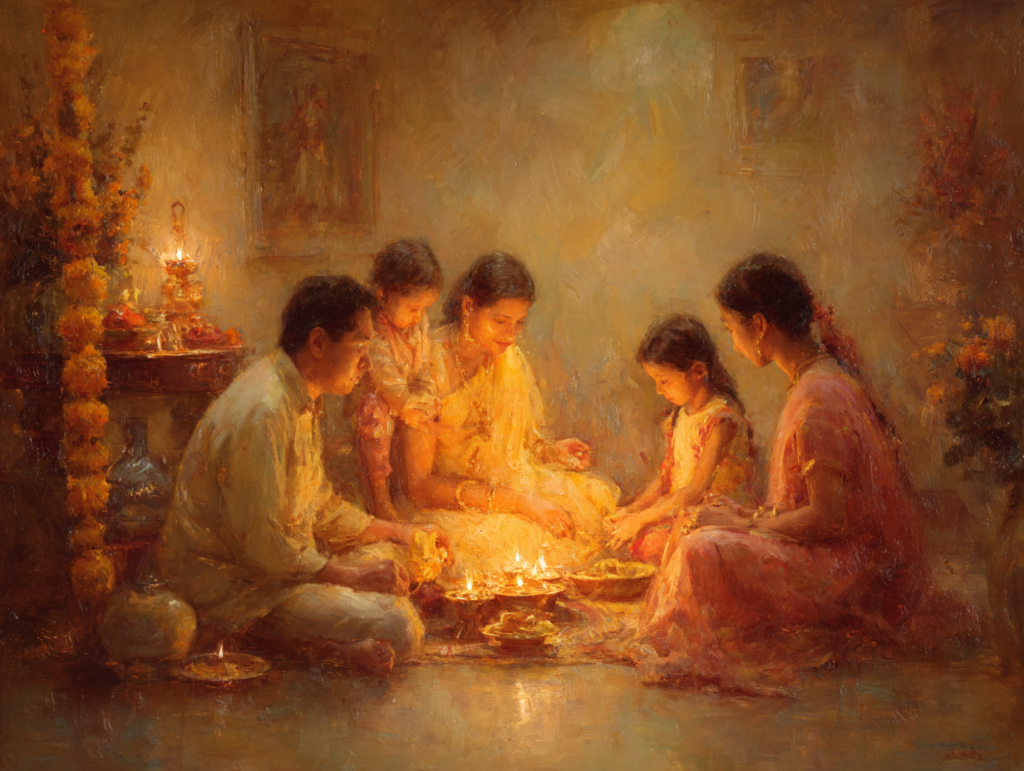
A Hindu American family's morning puja — the most powerful classroom in the home.
There is a moment every Hindu American parent knows well. Your child comes home from school and asks: "My teacher said Hinduism has 330 million gods — is that true?" Or simply: "Am I Indian or American?"
These questions are not problems. They are invitations — the beginning of one of the most meaningful conversations you will ever have with your child.
Raising Hindu children in America is not easy. But it is one of the most profound and rewarding journeys a Hindu American parent can take. This is our community's story, and it is worth telling well.
Understanding the challenge
The Unique Reality of the Hindu American Child
Hindu American children live between two worlds. At home, they witness puja, hear Sanskrit shlokas, smell incense and ghee lamps, and feel the warmth of festival celebrations. At school, they navigate a culture that rarely reflects any of it.
Many children feel what researchers call bicultural tension — feeling too "American" at home and too "Indian" at school. Studies show that when this tension goes unaddressed, some children begin to quietly shed their roots: skipping religious practices, distancing from cultural traditions, even feeling embarrassed about their faith — all in the pursuit of fitting in.
This isn't a character flaw. It is a natural response to an environment that does not reflect who they are.
"The answer is never to hide who you are. The answer is to know who you are so deeply that nothing can shake you."
The most powerful thing a Hindu American parent can do is model the life they want their children to inherit.
Children don't absorb values from lectures. They absorb them from watching you do a quick morning prayer before a busy workday. From seeing you help a neighbor without being asked. From watching you return to calm after a difficult moment.
Dharmik values — ahimsa (non-violence), satya (truthfulness), karuna (compassion), seva (selfless service) — are not taught. They are caught.
Festivals are not just celebrations — they are cultural anchors. Diwali, Navratri, Holi, Janmashtami, Ram Navami, Ganesh Chaturthi and many more — each one carries stories, values, and memories that bind a child to their heritage in ways that no textbook can.
Make them events your children own, not just attend:
- Let them help decorate the home for Diwali — give them ownership of the light
- Teach them the story behind each festival, not just the rituals
- Connect the celebration to a living value: Diwali is about the victory of light over darkness — what darkness are we lighting up in our own lives this year?
- Invite friends of all backgrounds — let your child be the one who explains and celebrates their tradition with pride
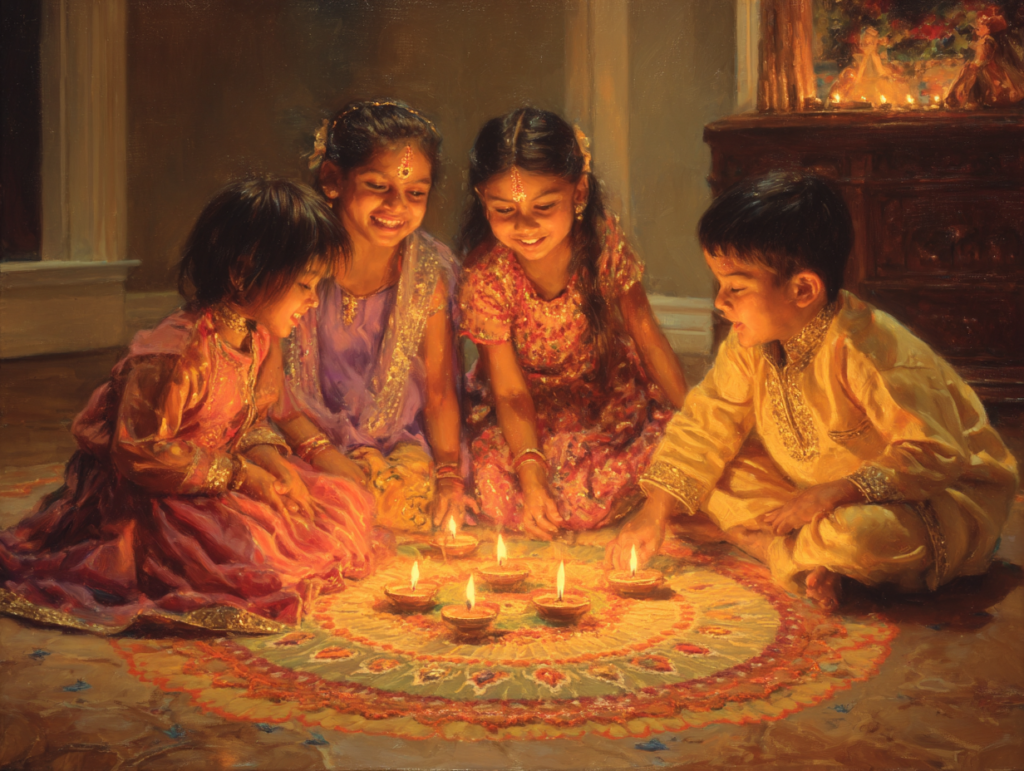
Children who make Rangoli together own their culture — not just observe it.
When your child comes home with a tough question about Hinduism — from a teacher, a textbook, or a classmate — resist the urge to either dismiss the question or become defensive.
Instead, sit down with them and explore it together. Hindu American parents sometimes feel caught off guard because children often only encounter Hinduism in school as a few buzzwords — and sometimes distorted ones. That gap between who we are and how we are represented is real.
But it is also an opportunity to teach your child something invaluable: how to think critically, stand with dignity, and speak with knowledge. Some useful phrases to model for your child:
- "That's a great question. Here's what our tradition actually teaches…"
- "Some people misunderstand this. Let me share the real story."
- "Our faith is more than 5,000 years old — there's a lot to explore. Want to find out together?"
The Bhagavad Gita is not just a scripture — it is a parenting manual for the ages. Its core message — do your duty with full effort, without attachment to outcome — is perhaps the most powerful antidote to the anxiety, comparison, and burnout that young people face today.
A student's dharma is to study hard, not to be first in the class. That single teaching can transform a child's relationship with school, failure, and success. You don't need a formal study program. Start small:
- Read one verse together at dinner and discuss what it means today
- When your child faces a tough decision, ask: "What would Arjuna's dharma be here?"
- Look for children's editions written in accessible language — several excellent ones exist specifically for the Hindu American diaspora
Hinduism has always understood that community is essential to spiritual life. The concept of sangha — a community of like-minded souls walking the path together — is not just for monasteries. It is for neighborhoods, temples, and living rooms.
Seek out:
- Local Hindu temples — not just for festivals, but for classes, youth groups, and seva opportunities
- Hindu cultural organizations in your area
- Online communities of Hindu American parents navigating the same journey
- Hindu Sunday schools (Bal Vihar) where children can bond with peers who share their heritage
One of the most common mistakes well-meaning parents make is enforcing culture rather than inviting children into it. Children won't care about their heritage unless they see you living it joyfully — and unless they are given agency within it.
Ask your child: What part of our tradition excites you? Maybe it's Bharatanatyam. Maybe it's cooking prasad. Maybe it's the philosophy, the music, the art, the yoga, or the epic stories of the Ramayana and Mahabharata.
Find their thread into Dharma and pull it gently.
Your children are Hindu Americans. Their dharma is to live fully in both realities — to carry the wisdom of Sanatana Dharma and to be a proud, contributing citizen of this nation. These are not in conflict.
In fact, many of Hinduism's core values — service to community, respect for all living beings, pursuit of knowledge, non-violence — align beautifully with the highest ideals of American civic life.
"One authentic connection to their tradition is worth more than a hundred enforced rituals. Find their thread into Dharma — and pull it gently."
A Word to the Parents Who Feel Like They're Failing
If you've ever felt like you're not doing enough — that your child doesn't know enough shlokas, hasn't been to enough temples, is slipping away from the culture — take a breath.
Dharmic parenting is not a performance. It is a relationship.
It is the quiet conversation about karma after something goes wrong. The moment you light a diya together on a dark evening. The time you sat with your child and said: "This is who we are, and we are proud of it."
Those moments are building something. Something ancient and durable. Something your child will carry long after they leave your home — and will one day, perhaps, pass on to their own children.
That is how Dharma lives. That is how it has always lived.
Hundreds of thousands of Hindu American families are walking this same path — in cities and suburbs, in temples and living rooms, in school parking lots and Sunday morning kitchens. DharmikAmerica.com exists to walk it with you.
This community is thriving. This faith is beautiful. This generation of Hindu American children is going to be extraordinary.Related Series · Raising Dharmic Americans
Go deeper — the complete 5-part parenting series
From daily puja routines to the Bhagavad Gita as a parenting manual — our full series covers every dimension of raising confident, grounded Hindu American children.
Read the Series: Rooted to Rise ↗